Journaling
Pomodoro StartOne task, one tiny first move, one focused block
Last updated
What Pomodoro Start is
The technique most people know is the twenty-five-minute work block with a short break after it. Pomodoro Start is the minute before the block. You write one thing to work on, concrete and finishable. You write the very first move, made tiny: not "do the taxes" but "find the receipts envelope". You pick a block length that feels doable today, from five minutes to twenty-five. The block length is a choice, not a rule: five minutes on the day the task has been avoided for a month, twenty-five on the day the work is already moving. Then you press start, set the phone aside and make the first move; the countdown runs on screen, and when it ends, nothing sounds, because you finish on your own terms. Two questions close it: did it get done, and one line on how it went.
Pomodoro Start vs the Eisenhower Quadrant
The Eisenhower Quadrant decides which task deserves attention. Pomodoro Start gets the chosen task started, which is a different problem and often the harder one.
How to do Pomodoro Start
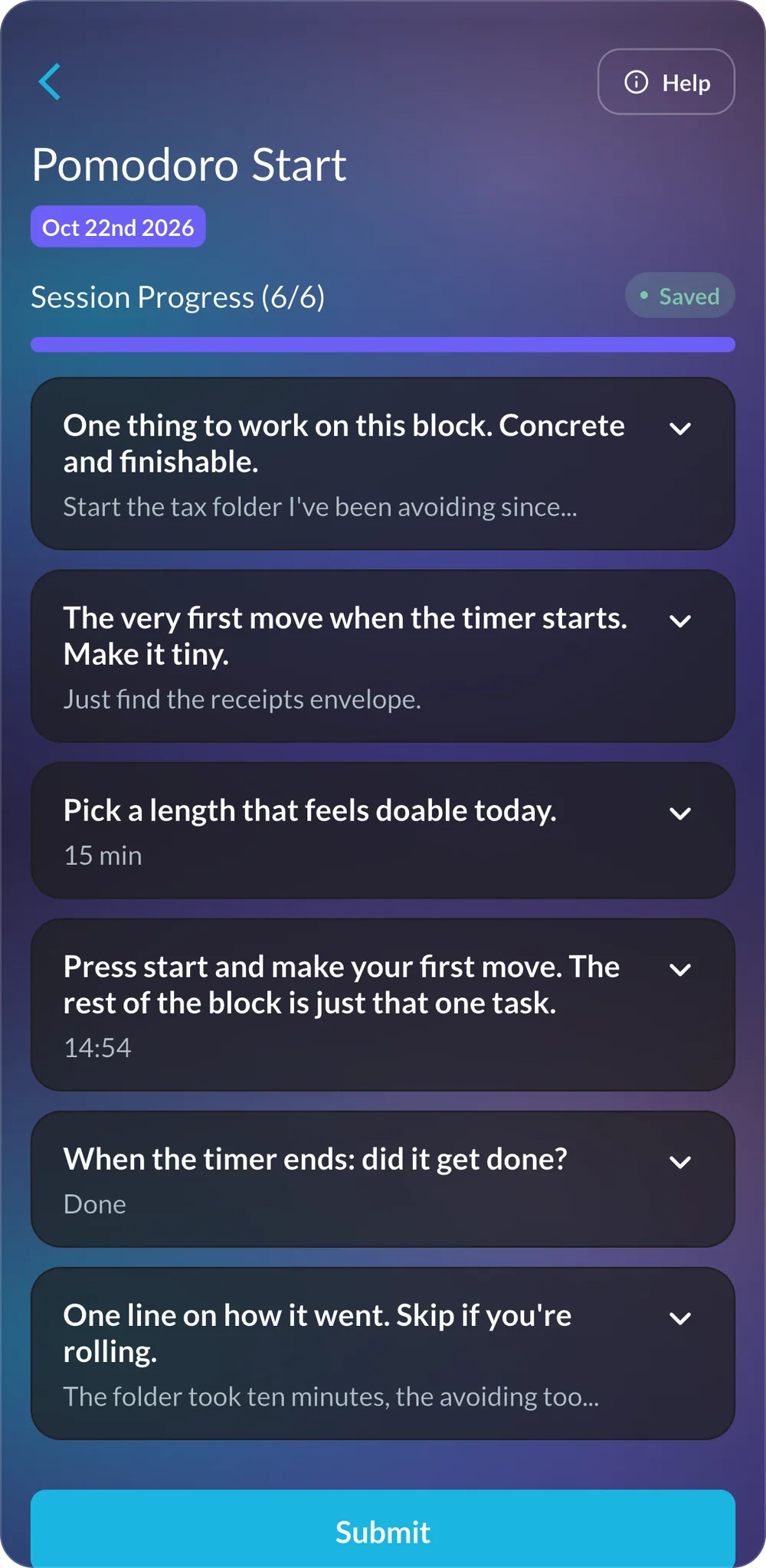
- One thing to work on this block. Concrete and finishable.
- The very first move when the timer starts. Make it tiny.
- Pick a length that feels doable today: five, ten, fifteen, twenty or twenty-five minutes.
- Press start and make your first move. The rest of the block is just that one task.
- When the timer ends: did it get done?
- One line on how it went. Skip if you're rolling.
A Pomodoro Start example
The task: start the tax folder I've been avoiding since March. First move: just find the receipts envelope. The block: fifteen minutes. Done. One line: the folder took ten minutes, the avoiding took four months.
In Breathtaking the exercise is guided, one question at a time, and the timer runs on screen while you work. If journaling is new to you, what journaling is and how it works covers the basics.
What happens when you write it down
Shrinking the work down to one task and one short interval lowers the mental barrier to starting, and naming it in writing turns a vague intention into a concrete commitment. A first move small enough to do in a minute leaves nothing to avoid. A short block with a visible end makes the effort finite. The two closing questions, did it get done and one line on how it went, are what turn a single block into a habit: the record shows that starting was smaller than the dread. You may feel the resistance to starting ease and a sense of clarity about what to do next.
What it's used for
Procrastination, the task that has been on the list for months. Work anxiety that grows the longer the work waits. A scattered morning that needs one thing to happen. The transition into focused work when the mind is still elsewhere.
What the research says about Pomodoro Start
The Pomodoro Technique has the strongest productivity research. A 2025 review of 32 studies with 5,270 total participants found strong correlations with improved focus (72% correlation), better time management (60% correlation), and increased engagement (68% correlation) (Assessing the efficacy of the Pomodoro technique in enhancing anatomy lesson retention, BMC Medical Education, 2025). Students using Pomodoro completed tasks 25% faster with 20% less fatigue and scored 17% higher on exams. The standard 25-minute work/5-minute break cycle appears optimal.
Where it comes from
The technique was created by Francesco Cirillo in the late 1980s, named after the tomato-shaped kitchen timer he used as a student. Time-boxing itself is older; Cirillo's contribution was the fixed short block and the rule that a block is indivisible. On the techniques page it sits with the modern methods.
When to use it
The start of any work session, especially the one you have been avoiding. Mid-afternoon, when focus has scattered and a fresh block resets it. With the smallest block on the hardest days. With one task, never a list; the second task belongs to the second block. It sits next to the Rapid Log, which gets everything out of your head first, and WOOP, which plans for the obstacle that stops you starting.
Pomodoro Start in Breathtaking
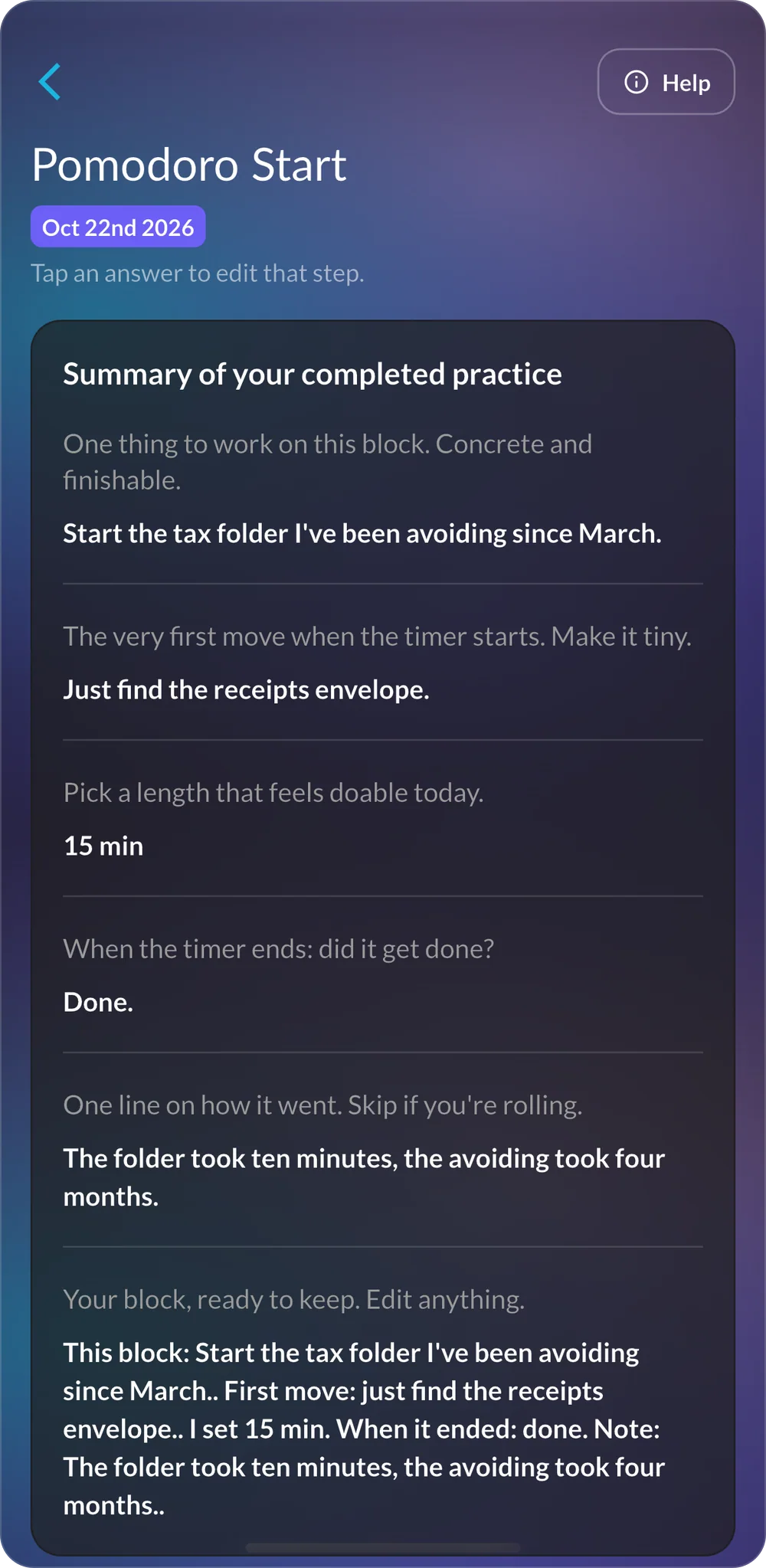
Journaling, self-paced, one question at a time, with a timer that runs on screen. Its job in the program is discipline. Your entries stay private and are not sent to an outside AI or sold for advertising or any other reason. In the app it is called Pomodoro Start.
Frequently asked questions
Is Pomodoro Start good for ADHD?
Short blocks with a clear end are easier to start than open-ended work, which is what Pomodoro Start sets up. The block can be as short as five minutes.
How long should a Pomodoro Start block be?
The research above found the standard 25-minute block with a 5-minute break appears optimal. Pomodoro Start lets you pick the block, from five minutes to twenty-five.
What are the disadvantages of Pomodoro Start?
The block can end mid-flow, and some work needs longer stretches. Pomodoro Start answers that by ending quietly, with no alarm and nothing stopping; if you are rolling, you keep going.
Related techniques
Breathtaking Premium gives you unlimited access to Pomodoro Start and 22 other journaling practices.
These practices are tools for nervous system regulation. The guide explains what it is, the signs you need it, and how to start.
Your personalized program picks one to three of these a day, in the minutes you have.
Try 7 days free