Journaling
Eisenhower QuadrantTasks sorted by urgent and important, into four boxes
Last updated
What the Eisenhower Quadrant is
Two questions sort everything. Important: does it help something that matters? Urgent: does it need to happen soon? Yes and yes goes in Do Now. Important but not urgent goes in Schedule. Urgent but not important goes in Delegate. Neither goes in Park. Do Now is the tax deadline and the child home sick; Schedule is the exercise, the call to a friend, the work that builds something; Delegate is the errand someone else could run; Park is the thing that will not matter in a month. Parking a task is not abandoning it; it stays on the list, out of the way, until it becomes important or disappears on its own. The Eisenhower matrix is the same tool drawn as a grid; the app draws it as four labeled boxes and then asks you to pick one Do Now task and write your first steps.
The Eisenhower Quadrant vs the Rapid Log
The Rapid Log captures everything and sorts it by time: today, this week, later. The Eisenhower Quadrant sorts by worth as well as time.
How to do the Eisenhower Quadrant
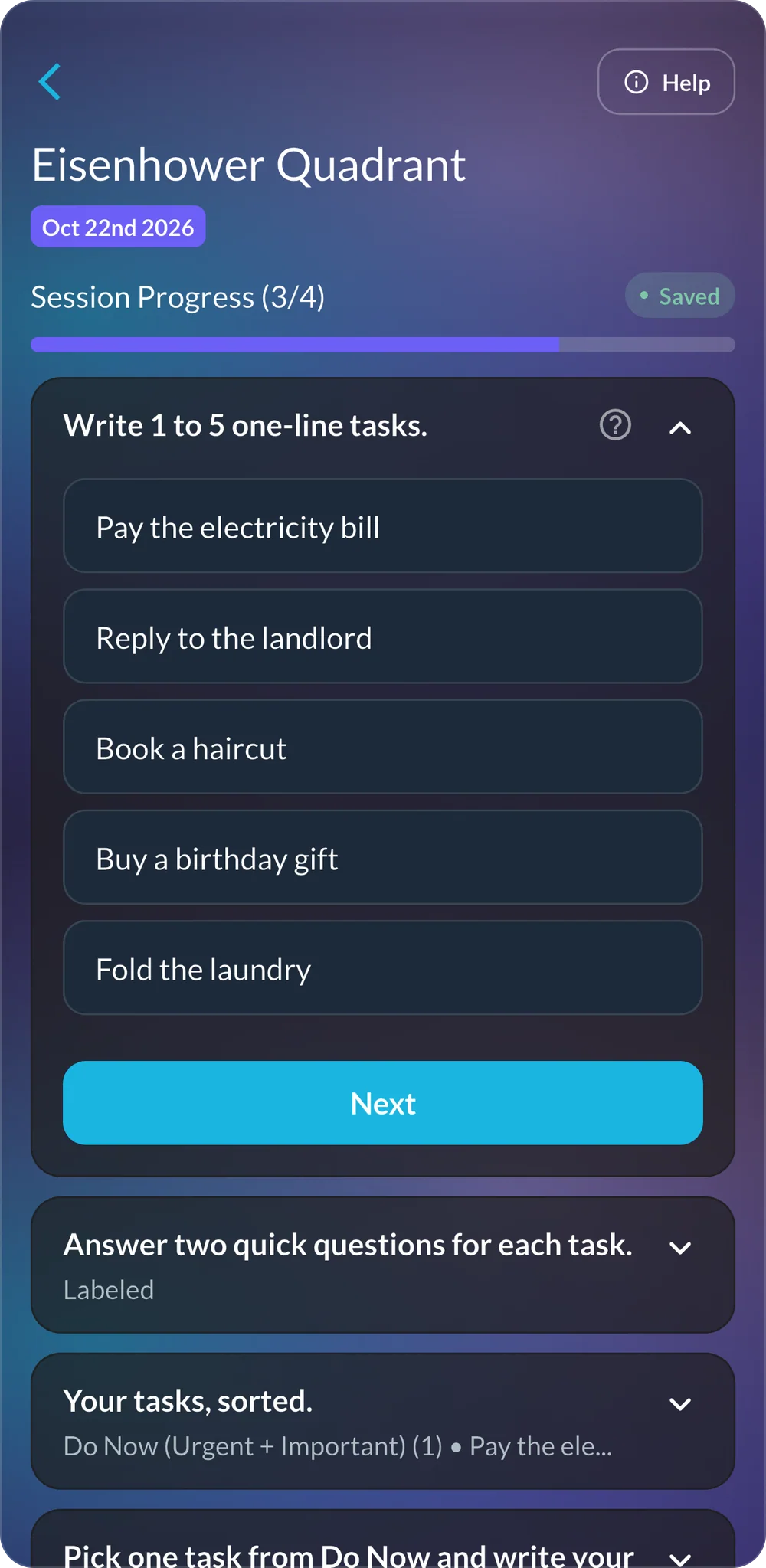
- Write one to five one-line tasks.
- For each task, answer two quick questions: Important? Urgent?
- Read your tasks sorted into the four boxes: Do Now, Schedule, Delegate, Park.
- Pick one task from Do Now and write your first steps on it.
An Eisenhower Quadrant example
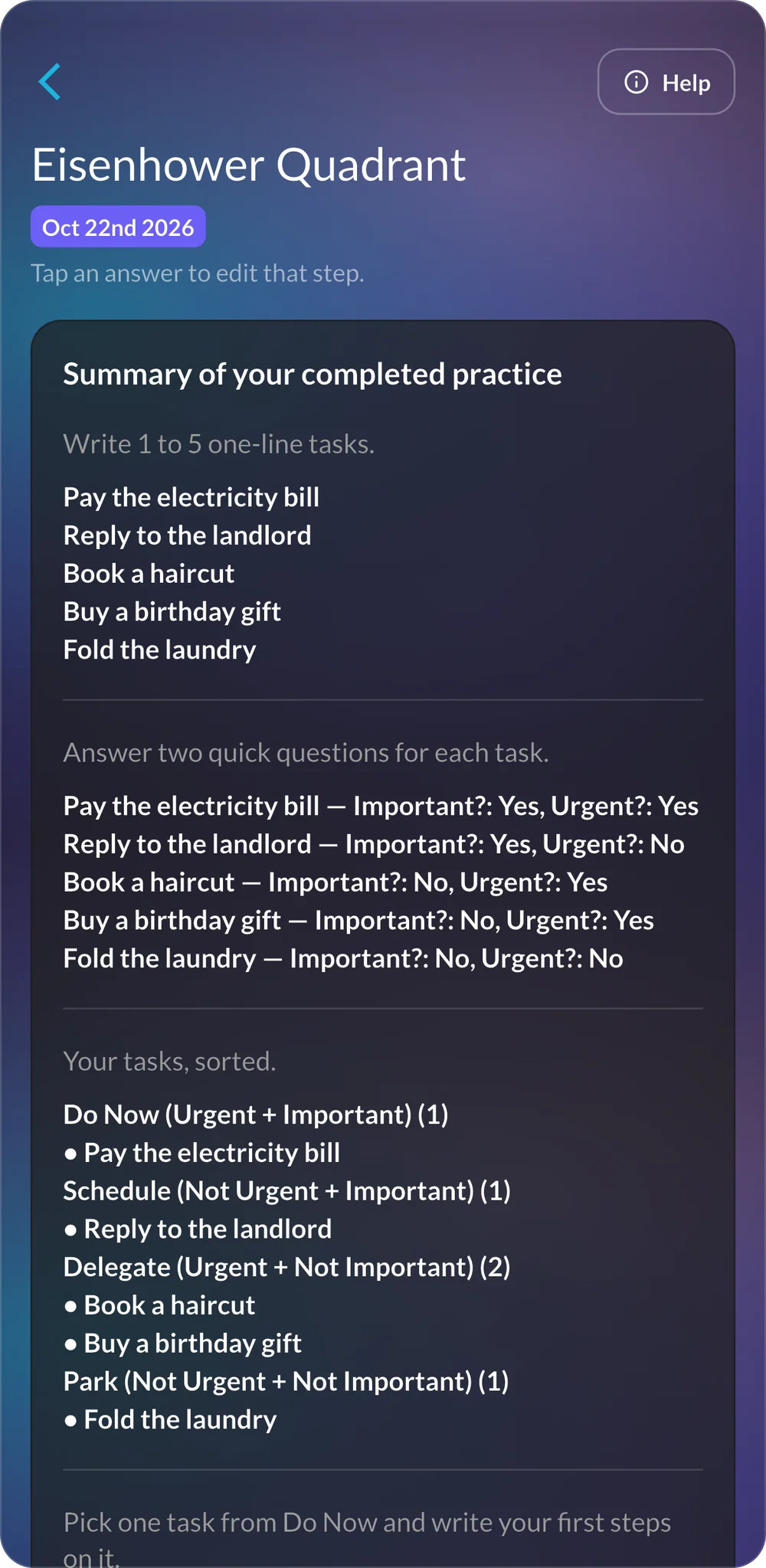
The tasks: pay the electricity bill, reply to the landlord, book a haircut, buy a birthday gift, fold the laundry. Pay the bill: important yes, urgent yes. Reply to the landlord: important yes, urgent no. Book a haircut: important no, urgent yes. Buy the gift: important no, urgent yes. Fold the laundry: important no, urgent no. Sorted: Do Now, pay the bill; Schedule, reply to the landlord; Delegate, book a haircut and buy the gift; Park, fold the laundry. First steps on the bill: find and open the bill and note the amount.
In Breathtaking the exercise is guided, one question at a time, and the app sorts the boxes for you. If journaling is new to you, what journaling is and how it works covers the basics.
What happens when you write it down
Separating urgent from important forces a clearer judgment about what truly matters, which keeps you from spending the day reacting to whatever feels pressing instead of doing what counts. You may feel a sense of relief and control as a chaotic list resolves into clear priorities. Writing first steps on one Do Now task, rather than staring at the whole box, is what turns the sorting into movement. The Delegate box is the one people resist; writing a name next to a task is the first admission that it does not have to be you.
What it's used for
Overwhelm, the morning the list is longer than the day. Work stress that comes from reacting instead of choosing. The person whose important things keep losing to urgent ones.
Where it comes from
The method is attributed to US President Dwight D. Eisenhower's approach to decisions, and to a line he quoted in a 1954 speech: the urgent are not important, and the important are never urgent. Stephen Covey drew it as a four-box grid in The 7 Habits of Highly Effective People in 1989, and that grid is the one productivity teaching uses. On the techniques page it sits with the modern methods.
When to use it
The start of a day, or a week, when the list has outgrown the time. Sunday evening for the week ahead works better than Monday morning, when the urgent has already started shouting. The moment everything feels both urgent and important. Weekly, if the Schedule box keeps emptying into next week. With five tasks at most; the practice is for deciding, not for cataloging, and a longer list belongs in the Rapid Log first. Five tasks sorted honestly do more than twenty sorted in a hurry, and the honest part is admitting which ones are only urgent. It sits next to Pomodoro Start, which starts the first Do Now task, and WOOP, which plans for the obstacle that keeps the important things parked.
The Eisenhower Quadrant in Breathtaking
Journaling, self-paced, one question at a time. Its job in the program is discipline. Your entries stay private and are not sent to an outside AI or sold for advertising or any other reason. In the app it is called Eisenhower Quadrant.
Frequently asked questions
What is the Eisenhower Quadrant, explained simply?
Two questions about each task, is it important and is it urgent, which sort everything into four boxes: do now, schedule, delegate, park. Then you work from the first box and protect the second.
Can you give an example of the Eisenhower Quadrant?
Pay the electricity bill: important and urgent, do now. Reply to the landlord: important, not urgent, schedule. Buy a gift: urgent, not important, delegate. Fold the laundry: neither, park.
How can the Eisenhower matrix be used in personal life?
The same way as at work: the bills, the calls, the errands and the chores all sort into the four boxes. Health, relationships and rest usually land in the Schedule box and get pushed out by urgent trivia, and that is the box to protect.
Related techniques
Breathtaking Premium gives you unlimited access to the Eisenhower Quadrant and 22 other journaling practices.
These practices are tools for nervous system regulation. The guide explains what it is, the signs you need it, and how to start.
Your personalized program picks one to three of these a day, in the minutes you have.
Try 7 days free