Journaling
WOOPWish, outcome, obstacle, plan, written in four steps
Last updated
What WOOP is
Most goal-setting stops at the wish and the outcome. WOOP adds the two steps that make the difference. The obstacle is the one inside you, a habit, a feeling, a thought, the too-tired voice or the one-more-episode pull, not the world's obstacles. The plan is an if-then: if that obstacle shows up, then I will do this specific thing. The wish should be something you can do in the next day or week, not a life goal; WOOP works on the achievable, and a wish you cannot reach produces only the fantasy half. Gabriele Oettingen calls the first half mental contrasting, holding the outcome and the obstacle side by side, and the second half an implementation intention, and the four letters are her method in the order she found works.
WOOP vs SMART goals
SMART goals make the wish specific and measurable. WOOP takes a specific wish and asks the question SMART never does, what in you will get in the way, and answers it in advance.
How to do WOOP
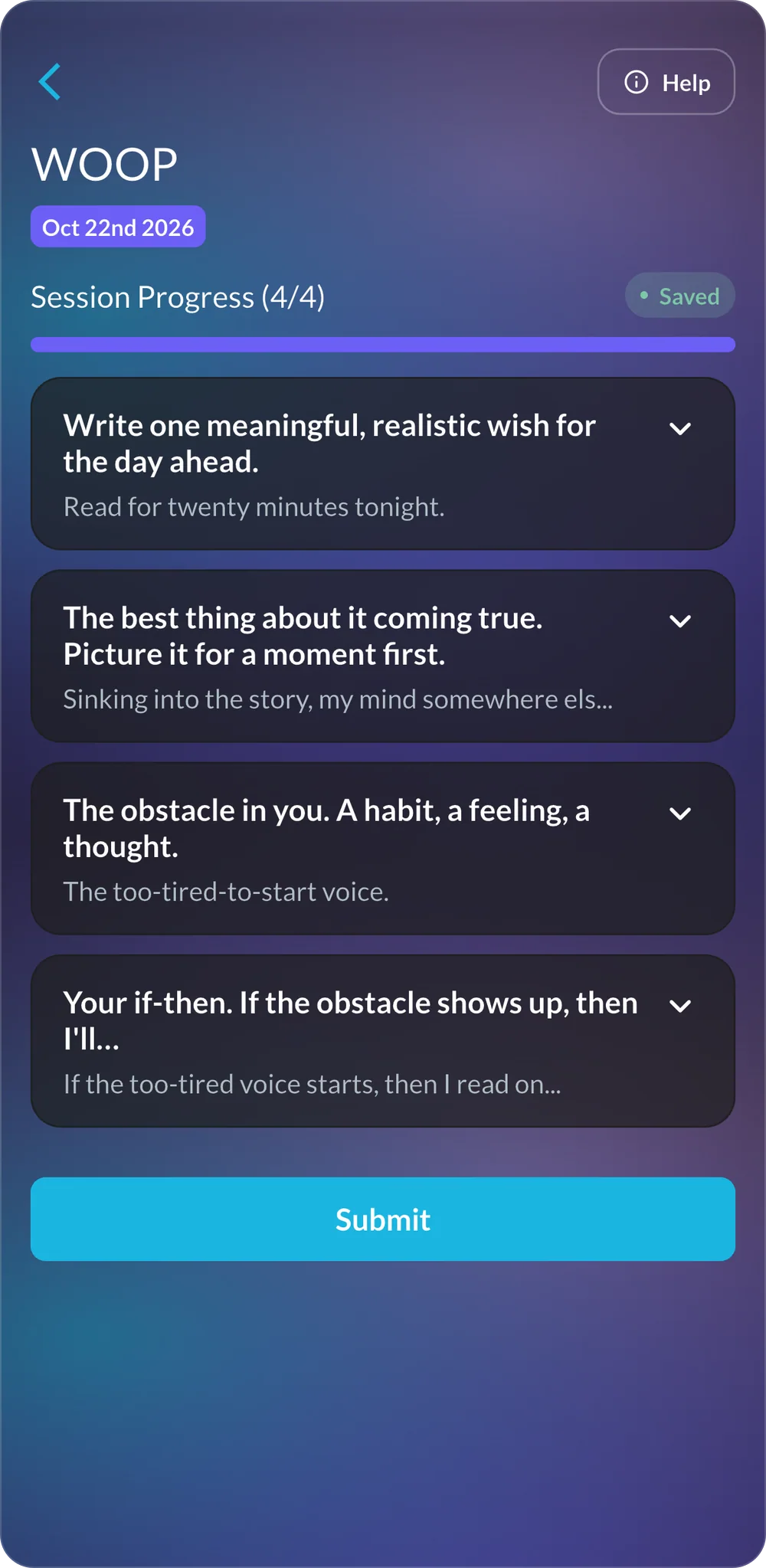
- Write one meaningful, realistic wish for the day ahead.
- The best thing about it coming true. Picture it for a moment first.
- The obstacle in you. A habit, a feeling, a thought.
- Your if-then. If the obstacle shows up, then I'll...
A WOOP example
Wish: read for twenty minutes tonight. Outcome: sinking into the story, my mind somewhere else for a while. Obstacle: the too-tired-to-start voice. Plan: if the too-tired voice starts, then I read one page, just one.
In Breathtaking the exercise is guided, one question at a time. If journaling is new to you, what journaling is and how it works covers the basics.
What happens when you write it down
Pairing a vivid picture of the outcome with an honest look at the obstacle, then making an if-then plan, harnesses two well-studied techniques, mental contrasting and implementation intentions, that make follow-through far more likely. Picturing the outcome first supplies the energy; naming the obstacle immediately after keeps the energy from turning into daydream. The if-then plan works because it is a decision made in advance: when the obstacle appears, the response is already chosen and the moment needs no willpower. You may feel both motivated by the wish and clear-eyed about the obstacle, with a concrete sense of what to do. The order matters: outcome before obstacle, so the wish is still warm when the obstacle is named, and obstacle before plan, so the plan has something specific to answer. A plan for an obstacle in the world, the traffic, the weather, other people, is a different exercise; WOOP works on the one in you. Naming the inner obstacle is the honest part, and the part most planning skips: the traffic is not what stops the run, the warm bed is.
What it's used for
A goal you keep setting and not starting. A habit that dies at the same obstacle every time. The day ahead, in the morning, with one wish for it. It works for the small wishes as well as the big ones: getting to bed by eleven, sending the difficult email, running twice this week. Any change of behavior, from bedtime to exercise to the hard conversation. The wish that is realistic but keeps losing to the evening. The habit you have started five times.
Where it comes from
WOOP is based on decades of research by psychologist Gabriele Oettingen on what actually turns goals into action. She developed WOOP as a practical, evidence-based method drawn from that research, pairing her own findings with Peter Gollwitzer's if-then plans. On the techniques page it sits with the modern methods.
When to use it
The morning, with one wish for the day. The night before something that matters. Weekly, with the same wish, until the if-then runs on its own. One wish at a time; a second wish gets its own WOOP on another day. It sits next to Pomodoro Start, which starts the first block once the plan exists, the Accountability Buddy Call, which adds a witness, and Stoic Premeditation, the ancient version of planning for what could go wrong.
WOOP in Breathtaking
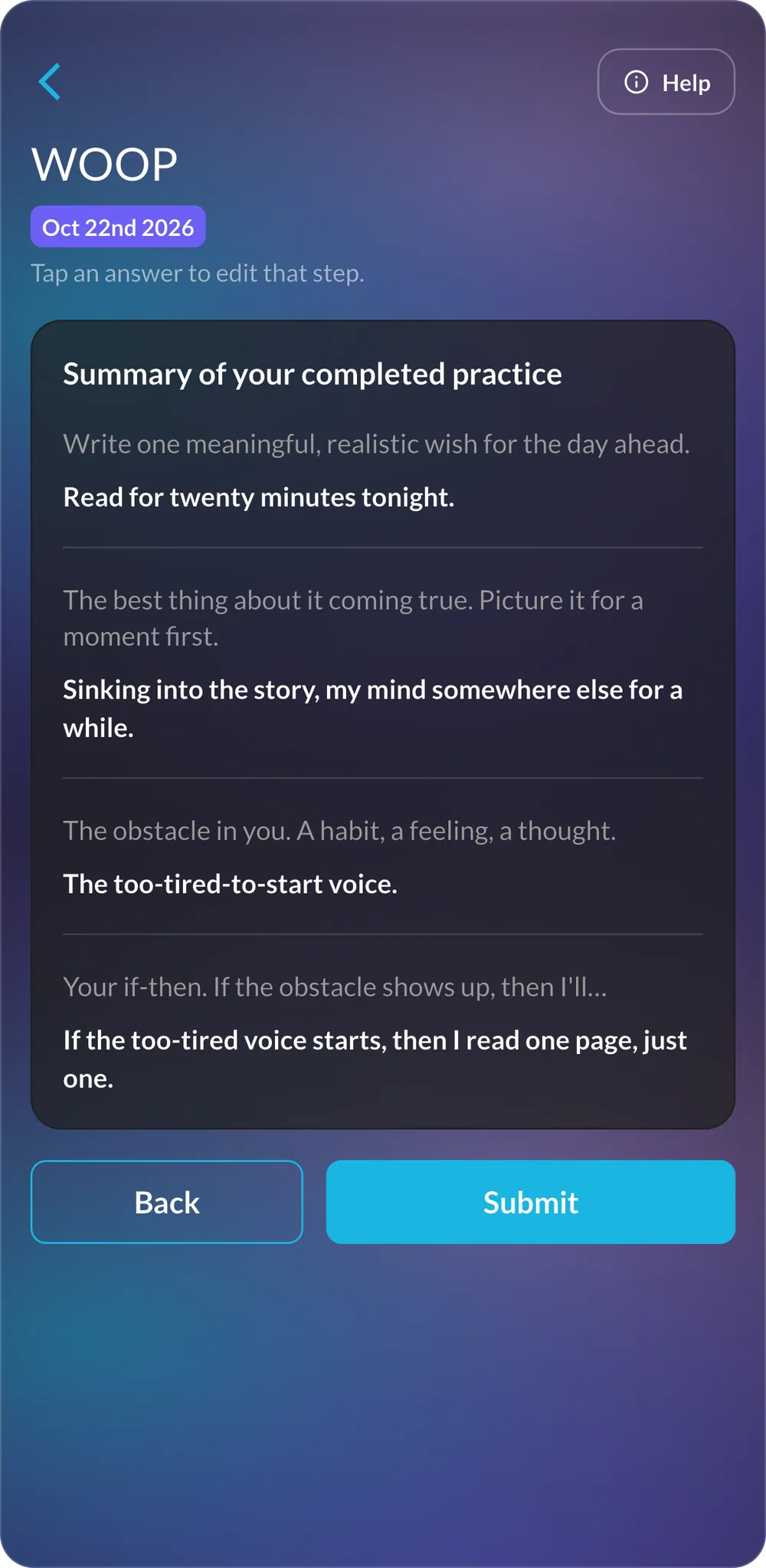
Journaling, self-paced, one question at a time. Its job in the program is discipline. Your entries stay private and are not sent to an outside AI or sold for advertising or any other reason. In the app it is called WOOP.
Frequently asked questions
What are the four steps of WOOP?
Wish: one meaningful, realistic goal. Outcome: the best thing about it coming true, pictured. Obstacle: the habit, feeling or thought in you that gets in the way. Plan: if that obstacle shows up, then I will do this.
What is the difference between WOOP and SMART goals?
SMART makes the goal specific, measurable, achievable, relevant and time-bound. WOOP starts from a realistic wish and adds what SMART leaves out, the inner obstacle and an if-then plan for it; the two can be used together.
How do you use WOOP every day?
One wish for the day ahead, written in the morning, with its outcome, its obstacle and its plan. WOOP gets faster with practice until the four steps happen in your head.
Related techniques
Breathtaking Premium gives you unlimited access to WOOP and 22 other journaling practices.
These practices are tools for nervous system regulation. The guide explains what it is, the signs you need it, and how to start.
Your personalized program picks one to three of these a day, in the minutes you have.
Try 7 days free