Journaling
Poetry Slam DraftA feeling poured into four quick, unpolished lines
Last updated
What the Poetry Slam Draft is
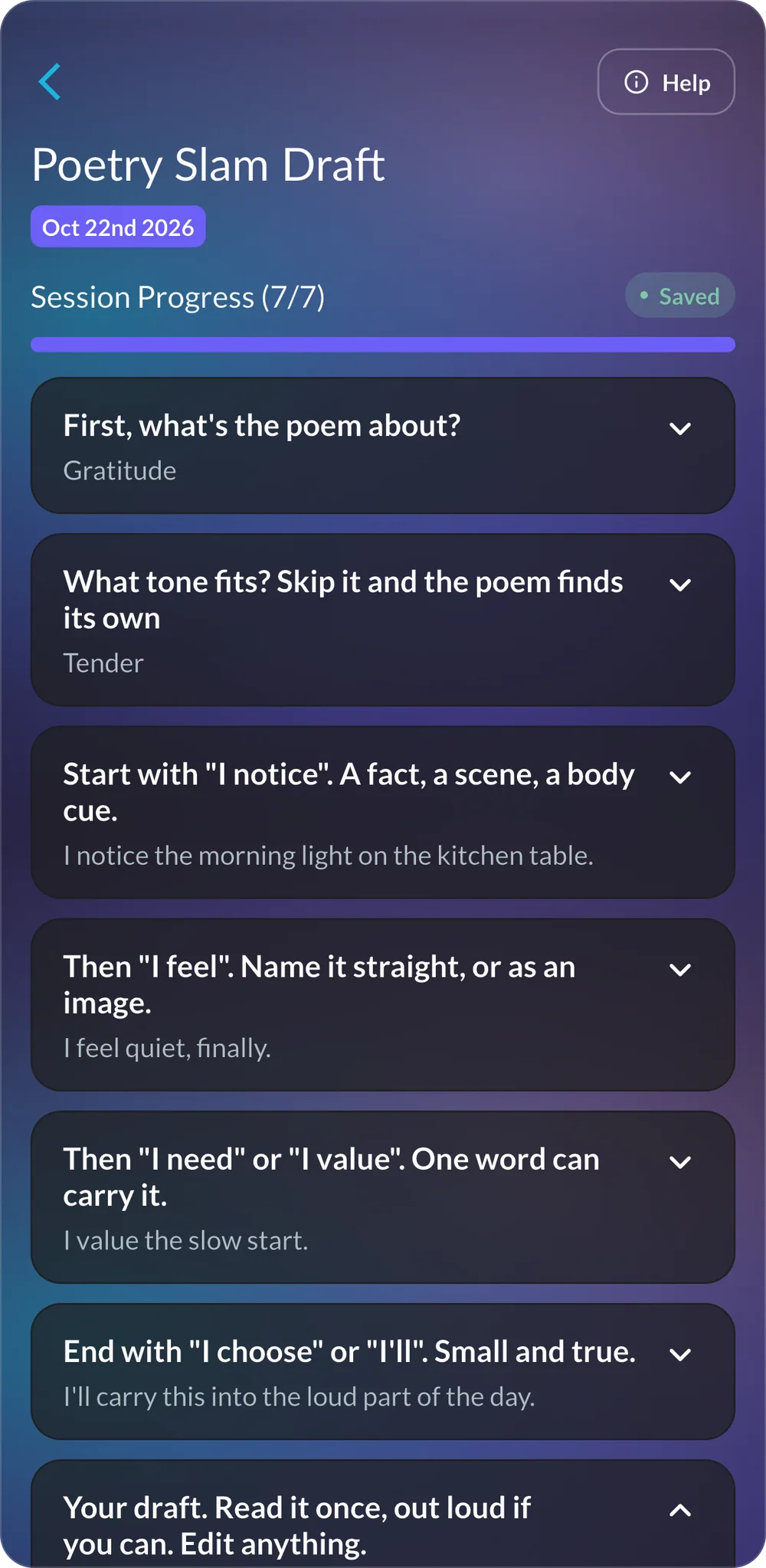
Slam poetry is spoken, personal and raw, and the draft borrows its permission: the feeling matters, the craft does not. The app gives the poem a skeleton: four fixed openings. You pick a theme, gratitude, stress, a boundary, a small win, and a tone if you want one, then write four lines with four fixed openings. I notice: a fact, a scene, a body cue. I feel: the feeling, straight or as an image. I need, or I value: one word can carry it. I choose, or I'll: something small and true. The four lines are assembled into the draft, and you read it once, out loud if you can.
How to do the Poetry Slam Draft
- First, what's the poem about? Gratitude, hope, a small win, a decision, stress, overwhelm, anger, sadness, guilt, longing, a boundary.
- What tone fits? Honest, tender, fierce, playful, quiet, matter-of-fact, or skip it and the poem finds its own.
- Start with "I notice". A fact, a scene, a body cue.
- Then "I feel". Name it straight, or as an image.
- Then "I need" or "I value". One word can carry it.
- End with "I choose" or "I'll". Small and true.
- Read your draft once, out loud if you can, and edit anything.
A Poetry Slam Draft example
Theme: gratitude. Tone: tender. I notice the morning light on the kitchen table. I feel quiet, finally. I value the slow start. I'll carry this into the loud part of the day.
In Breathtaking the exercise is guided, one line at a time, and the draft is assembled from your four lines. If journaling is new to you, what journaling is and how it works covers the basics.
What happens when you write it down
Shaping a feeling into words and images gives it form and some distance, which can be both a release and a way of understanding the emotion more deeply. Notice, feel, need, choose is the arc from a raw state to a small action, in four lines. Saying "I feel like a phone at two percent" tells you something "I'm tired" does not. You may feel self-conscious at first, then absorbed, and often a release or satisfaction in giving a feeling shape.
What it's used for
A big feeling that needs somewhere to go. The person who finds structured journaling dry and free writing shapeless. A creative block, because four lines is always possible.
Where it comes from
It draws on the spoken-word and slam poetry tradition, born in Chicago in the 1980s, where raw, personal expression matters more than polish, and on the therapeutic use of poetry writing that goes back further. On the techniques page it sits with the modern methods.
When to use it
Whenever a feeling is too big for a mood check and too vague for a thought log. The evening, as a way of putting the day into four lines. It sits next to Free Write, for the days the feeling needs more room than four lines, the Emotion Wheel, for finding the word in line two, and Joy Amplification, for the good feelings.
The Poetry Slam Draft in Breathtaking
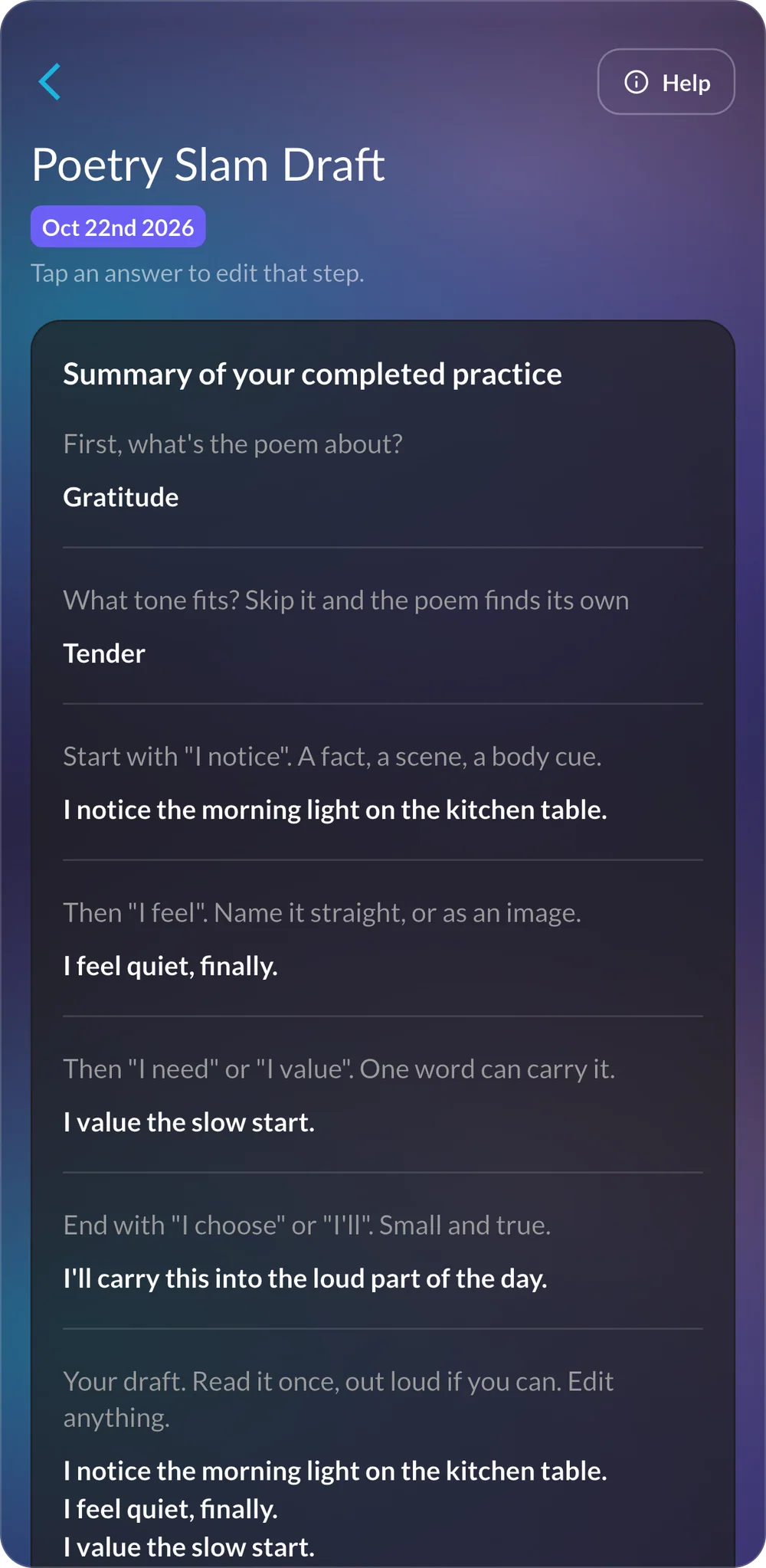
Journaling, self-paced, one question at a time. Its job in the program is insight. Your entries stay private and are not sent to an outside AI or sold for advertising or any other reason. In the app it is called Poetry Slam Draft.
Related techniques
Breathtaking Premium gives you unlimited access to the Poetry Slam Draft and 22 other journaling practices.
These practices are tools for nervous system regulation. The guide explains what it is, the signs you need it, and how to start.
Your personalized program picks one to three of these a day, in the minutes you have.
Try 7 days free