Journaling
Emotion WheelFrom a vague feeling to the precise word underneath it
Last updated
What the Emotion Wheel is
A feelings wheel puts the big emotions at the center and their precise shades around the rim, so that you can start from a gut sense and travel outward to the exact word. Breathtaking's wheel has eight families: angry, sad, worried, disgusted, joyful, connected, tired and flat. Inside each sit the words that matter: angry opens into annoyed, frustrated, resentful, impatient and enraged; tired into drained, foggy, sleepy, wired-but-tired and heavy. You pick the family with your gut, then feel the difference between the words before you pick one, then rate its intensity, find where it lives in the body, and, if naming it was not enough, ask what would help. Resentful and impatient are both angry, and they need different things.
The Emotion Wheel vs the 3 Question Mood Check
The 3 Question Mood Check names the feeling and moves on to its cause and a helpful line. The Emotion Wheel stays with the naming, adding the intensity, the place in the body and what would help, which makes it the one for a feeling you cannot place.
How to do the Emotion Wheel
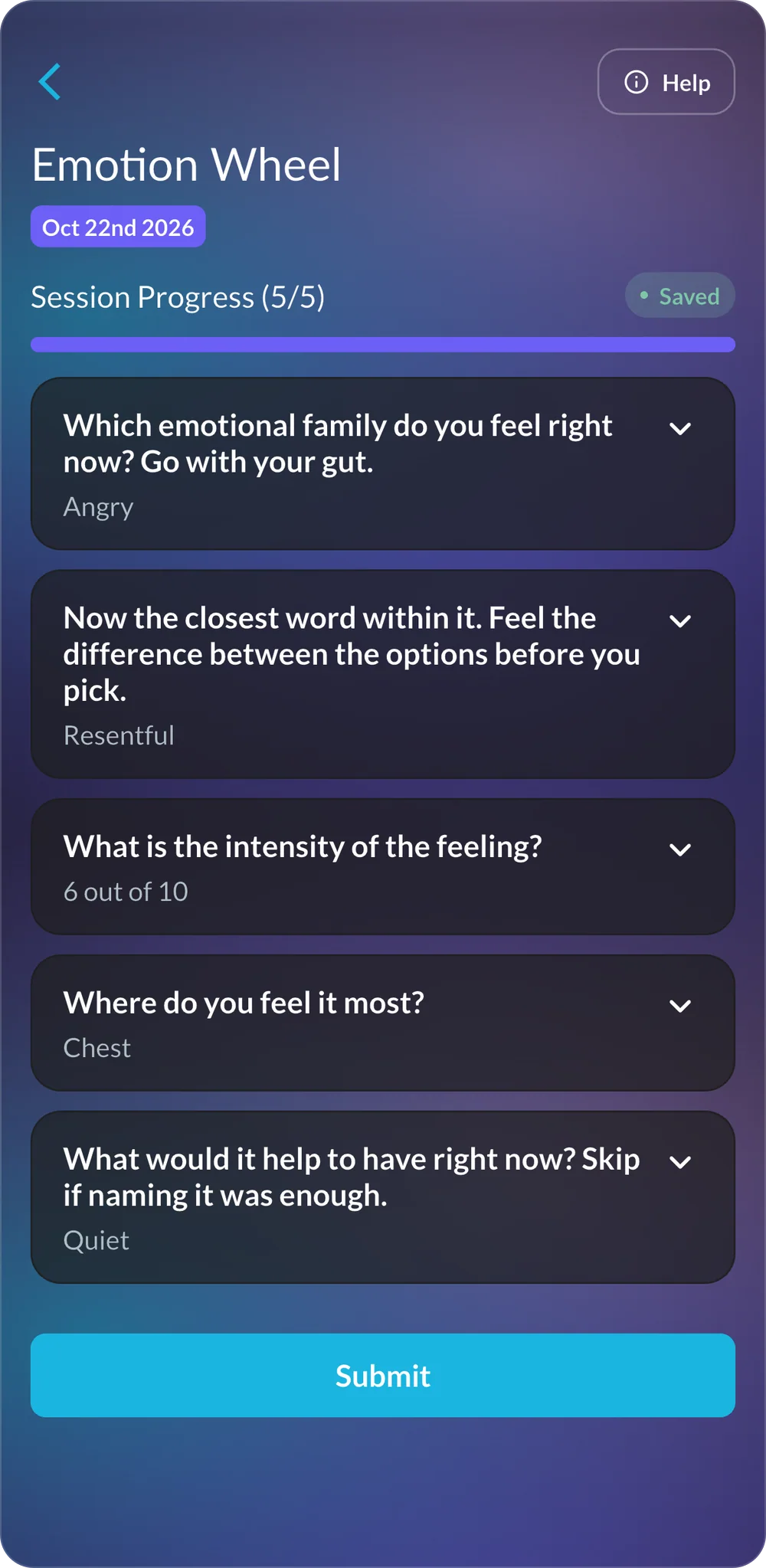
- Which emotional family do you feel right now? Go with your gut.
- Now the closest word within it. Feel the difference between the options before you pick.
- What is the intensity of the feeling, from 0 to 10?
- Where do you feel it most? Chest, throat, stomach, head, shoulders, back, hands.
- What would it help to have right now? Quiet, movement, a plan, reaching out, food or water, rest, warmth. Skip if naming it was enough.
An Emotion Wheel example
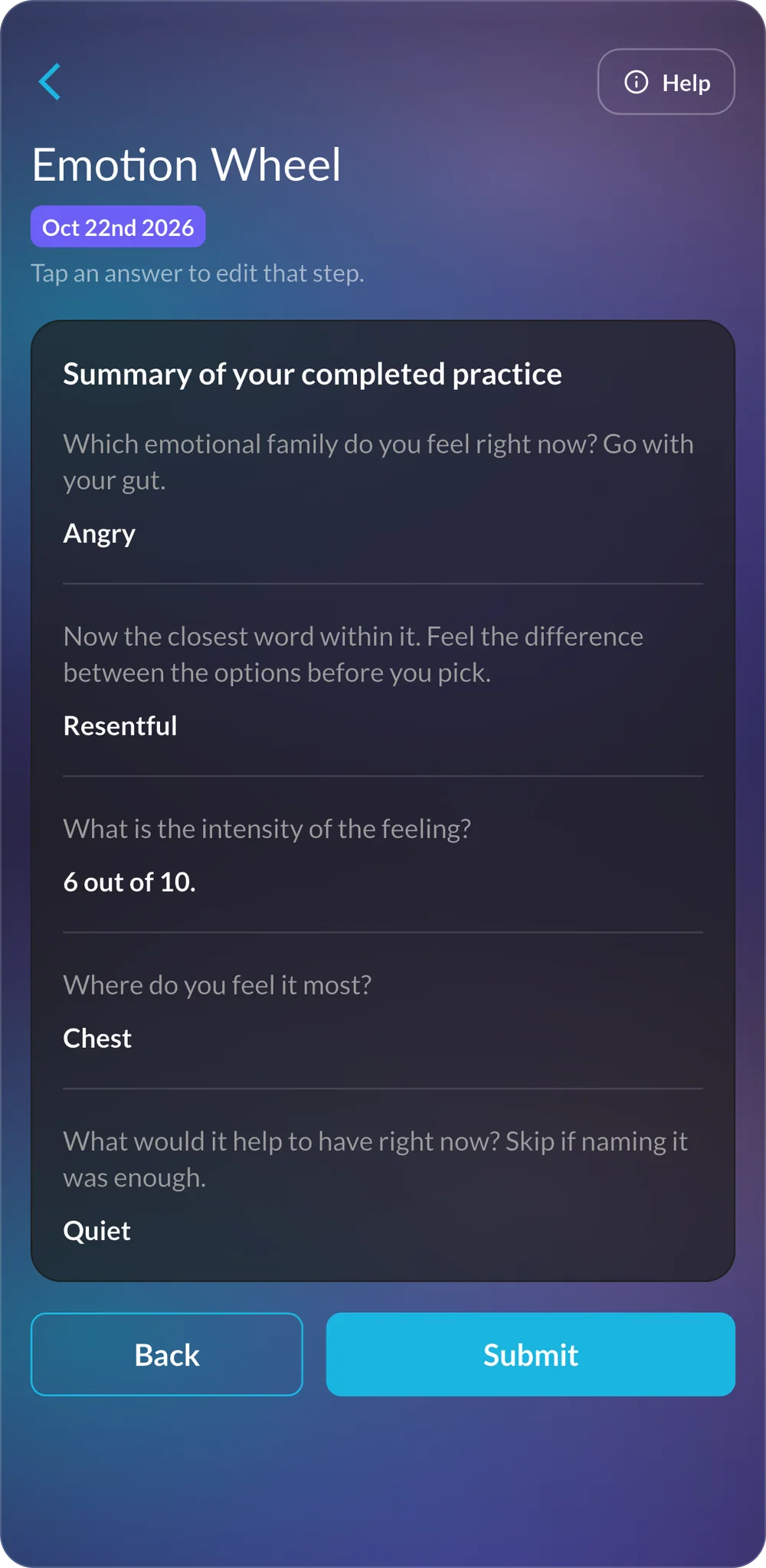
Family: angry. Word: resentful. Intensity: 6 out of 10. In the body: chest. What helps: quiet.
In Breathtaking the exercise is guided, one question at a time, and the second question's words change with the family you picked. If journaling is new to you, what journaling is and how it works covers the basics.
What happens when you write it down
Moving from a broad feeling to a precise one, affect labeling at a finer grain, gives the emotion shape and reduces its grip, which makes it easier to understand and work with. Finding it in the body adds a second handle on the feeling. You may feel a click of recognition when you land on the right word, along with whatever that named emotion brings.
What it's used for
A feeling you cannot place. Mixed emotions that arrive together and need separating. The moment before you react, so the reaction fits the feeling. Anyone who was never taught the words.
What the research says about the Emotion Wheel
Using an emotion wheel to identify specific feelings (rather than just "good" or "bad") builds on research showing that people with higher emotional granularity have less depression, better anxiety management, and lower rates of addiction (The theory of constructed emotion: an active inference account of interoception and categorization, Barrett, 2017). While no studies test the emotion wheel specifically, the practice draws on robust research showing that precisely labeling emotions helps regulate them (Affect labeling studies by Lieberman et al., 2007).
Where it comes from
Emotion wheels were developed by psychologists mapping how core emotions branch into more specific ones, and are widely used in emotional-literacy work. Robert Plutchik drew the first in 1980, with eight primary emotions and their blends; the wheel most people know, with families at the center and shades at the rim, was Gloria Willcox's 1982 version for use in therapy. On the techniques page it sits with the modern methods.
When to use it
The moment a feeling arrives without a name. Before a conversation, so you know what you are bringing into it. Daily for a couple of weeks if the words do not come easily; the vocabulary builds. It sits next to the CBT Thought Log, which takes the named feeling on to the thought behind it, and NVC Reflection, which takes it on to the need underneath.
The Emotion Wheel in Breathtaking
Journaling, self-paced, one question at a time. Calming; its job in the program is defusion, getting distance from a feeling by naming it. Your entries stay private and are not sent to an outside AI or sold for advertising or any other reason. In the app it is called Emotion Wheel.
Frequently asked questions
How does the Emotion Wheel work?
You start at the center with a broad family, angry, sad, worried, and move outward to the precise word inside it, resentful, lonely, uneasy. Then you rate the intensity, find where it sits in the body, and ask what would help.
What are the 8 core emotions on the Emotion Wheel?
In Breathtaking's wheel: angry, sad, worried, disgusted, joyful, connected, tired and flat. Plutchik's original eight were joy, trust, fear, surprise, sadness, disgust, anger and anticipation; a feelings wheel varies by who drew it.
Is the Emotion Wheel part of CBT?
It is used in CBT and in other therapies, because naming the feeling precisely is usually the first step. It works on its own, without the rest of CBT.
Related techniques
Breathtaking Premium gives you unlimited access to the Emotion Wheel and 22 other journaling practices.
These practices are tools for nervous system regulation. The guide explains what it is, the signs you need it, and how to start.
Your personalized program picks one to three of these a day, in the minutes you have.
Try 7 days free