Journaling
Free WriteWriting continuously about whatever comes, without stopping to edit
Last updated
What Free Write is
Freewriting has one rule: keep writing. No editing, no crossing out, no going back to fix a sentence, no judging whether it is any good, and no stopping when you run out; when you run out, you write "I don't know what to write" until something comes, and something always does. The result is not for anyone, not even for you to reread unless you want to. It is the writing equivalent of talking to yourself in the car.
Free Write vs the Rapid Log
The Rapid Log captures tasks and events in short lines and sorts them. Free Write captures everything else, the unsorted stuff underneath the list.
How to do Free Write
- How long do you want to write for? Five minutes, ten, or no timer.
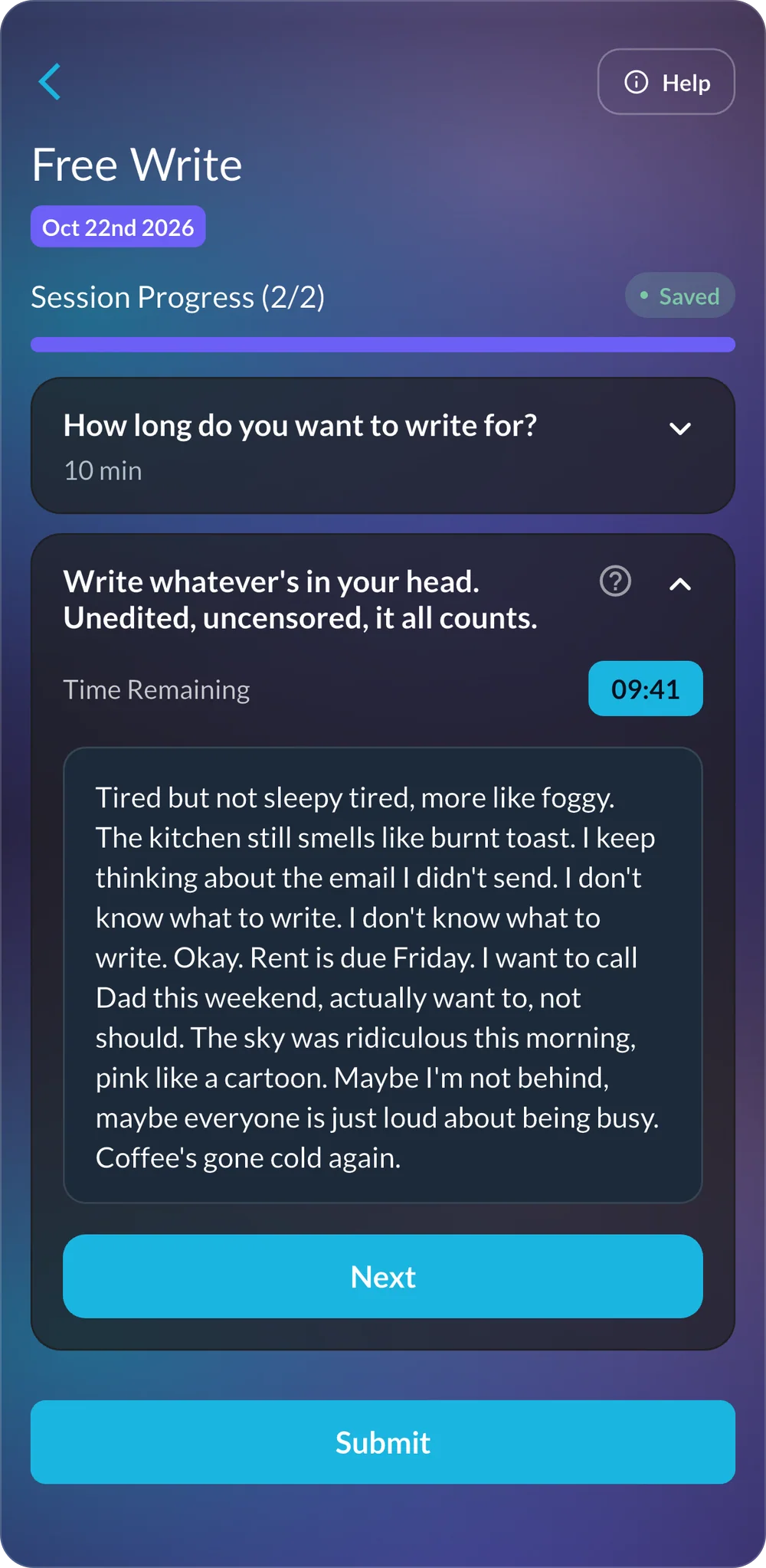
- Write whatever's in your head. Unedited, uncensored, it all counts.
Stuck? Write "I don't know what to write" until words come. When the time is up, you are done; nothing needs to be reread.
A Free Write example
Ten minutes. "Tired but not sleepy tired, more like foggy. The kitchen still smells like burnt toast. I keep thinking about the email I didn't send. I don't know what to write. I don't know what to write. Okay. Rent is due Friday. I want to call Dad this weekend, actually want to, not should. The sky was ridiculous this morning, pink like a cartoon. Maybe I'm not behind, maybe everyone is just loud about being busy. Coffee's gone cold again."
In Breathtaking the exercise is guided: pick the length, and the timer counts down above the page while you write. If journaling is new to you, what journaling is and how it works covers the basics.
What happens when you write it down
Writing without stopping or censoring bypasses the inner editor and lets thoughts spill out, which both clears mental noise and often surfaces feelings or ideas you didn't know were there. The rule against stopping is what does it: the editing mind cannot keep up with a hand that will not pause, so what reaches the page is closer to what is actually there. Ten minutes of it empties the queue of half-thoughts that were using up attention in the background. You may feel resistance at first, then a loosening as the words start to flow, and sometimes surprise at what comes out.
What it's used for
Mental fog, the feeling of too many tabs open. A creative block. The morning, before the day fills up. Finding out what is actually bothering you when you cannot tell. The night before a decision, to hear what you already think.
What the research says about Free Write
Over 400 studies since 1986 have tested expressive writing about emotional experiences. Writing for 15-20 minutes over 3-4 days produces consistent benefits: 35-50% reduction in doctor visits, improved immune function, better sleep, and reduced depression and anxiety (Written emotional expression: effect sizes, outcome types, and moderating variables, Smyth, 1998; Expressive Writing in Psychological Science, Pennebaker, 2017). Recent research shows you need to write at least 1,722 words total to see benefits; engagement matters more than just doing it.
Where it comes from
It draws on stream-of-consciousness and morning-pages style practices long used by writers and therapists to free up thinking. Peter Elbow made the practice a method in 1973; Julia Cameron's morning pages, three longhand pages every morning, made it a daily habit in 1992; and James Pennebaker's expressive writing studies from 1986 gave it the research base. On the techniques page it sits with the modern methods.
When to use it
Ten minutes is the usual length; five is enough on a full day, and no timer is for the days that need the room. First thing in the morning, before the phone. Any time the head is full and the thinking has stopped moving. Three or four days in a row when something is weighing on you, which is the dose the research used. It sits next to the Poetry Slam Draft, which gives a feeling a shape, and Examen Journaling, which reviews the day with structure once the clutter is gone.
Free Write in Breathtaking
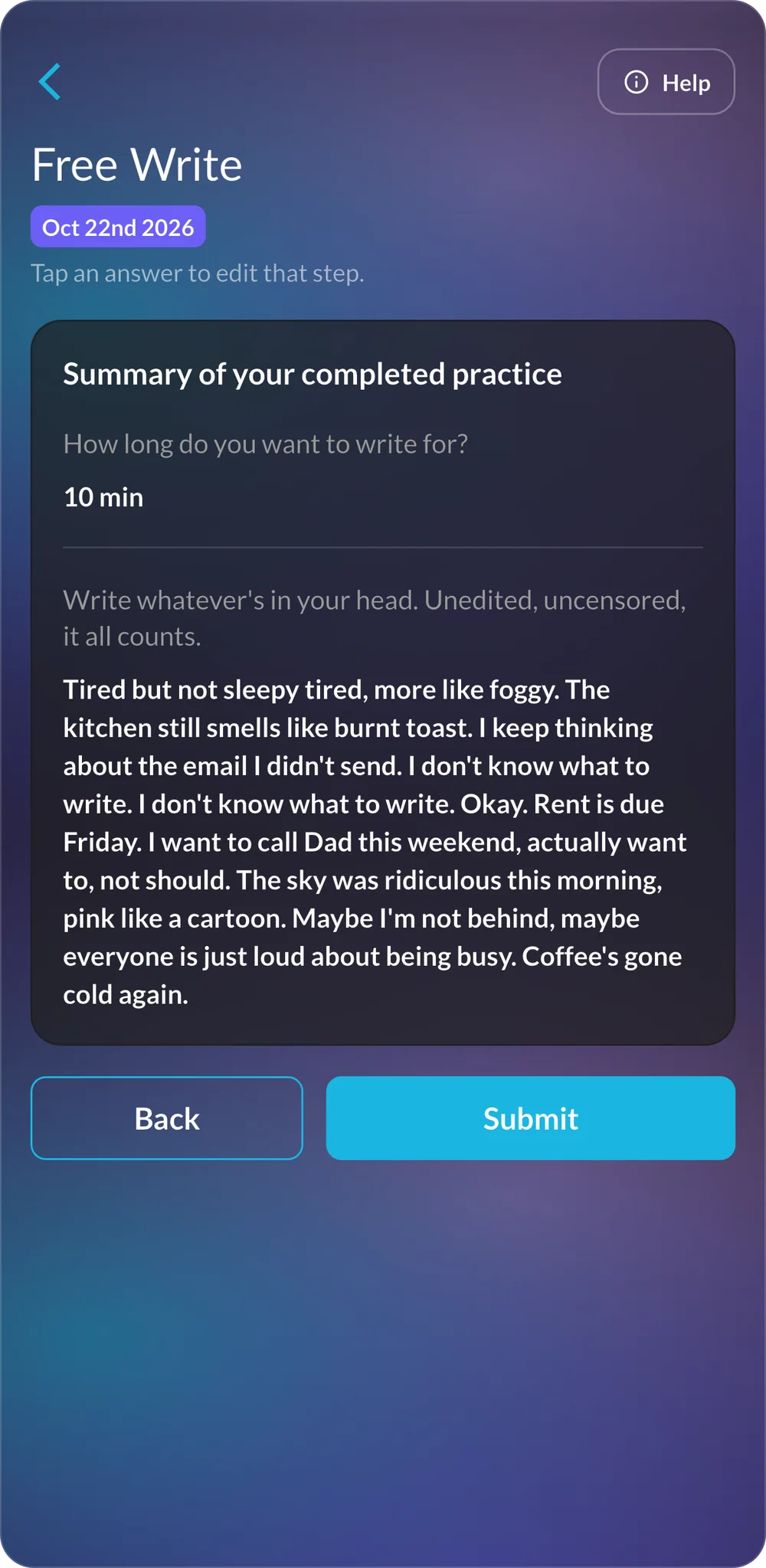
Journaling, self-paced, one question at a time, with a timer you set. Its job in the program is defusion, with insight second. Your entries stay private and are not sent to an outside AI or sold for advertising or any other reason. In the app it is called Free Write.
Frequently asked questions
What is the difference between freewriting and journaling?
Most journaling has a subject: the day, a feeling, a question. Free Write has none; you write whatever comes for a set time without stopping, and the subject finds itself.
Can you give an example of a Free Write?
"Tired but not sleepy tired, more like foggy. The kitchen still smells like burnt toast. I keep thinking about the email I didn't send. I don't know what to write." It goes on like that, unedited, until the timer ends.
How long should a Free Write be?
Five or ten minutes is enough to clear the head; the app offers both, or no timer. The research on expressive writing used fifteen to twenty minutes on three or four days.
Related techniques
Breathtaking Premium gives you unlimited access to Free Write and 22 other journaling practices.
These practices are tools for nervous system regulation. The guide explains what it is, the signs you need it, and how to start.
Your personalized program picks one to three of these a day, in the minutes you have.
Try 7 days free