Journaling
Gratitude JournalA person, yourself, and one small thing, with the why
Last updated
What the Gratitude Journal is
Most gratitude journals ask for three good things. Breathtaking's version asks for three particular ones, so the practice does not collapse into the same three every night. A person you are thankful for today, and why. One thing about yourself you are thankful for today, and why, which is the corner people skip. One small thing around you, and why. The why matters: a reason turns a list into a noticing. The app assembles the three into one paragraph of thanks.
The Gratitude Journal vs Gratitude Meditation
Gratitude Meditation stays with the feeling of appreciation in the moment, eyes closed. The Gratitude Journal writes it down with the reasons, which makes it concrete and builds a record you can reread on a bad day.
How to do the Gratitude Journal
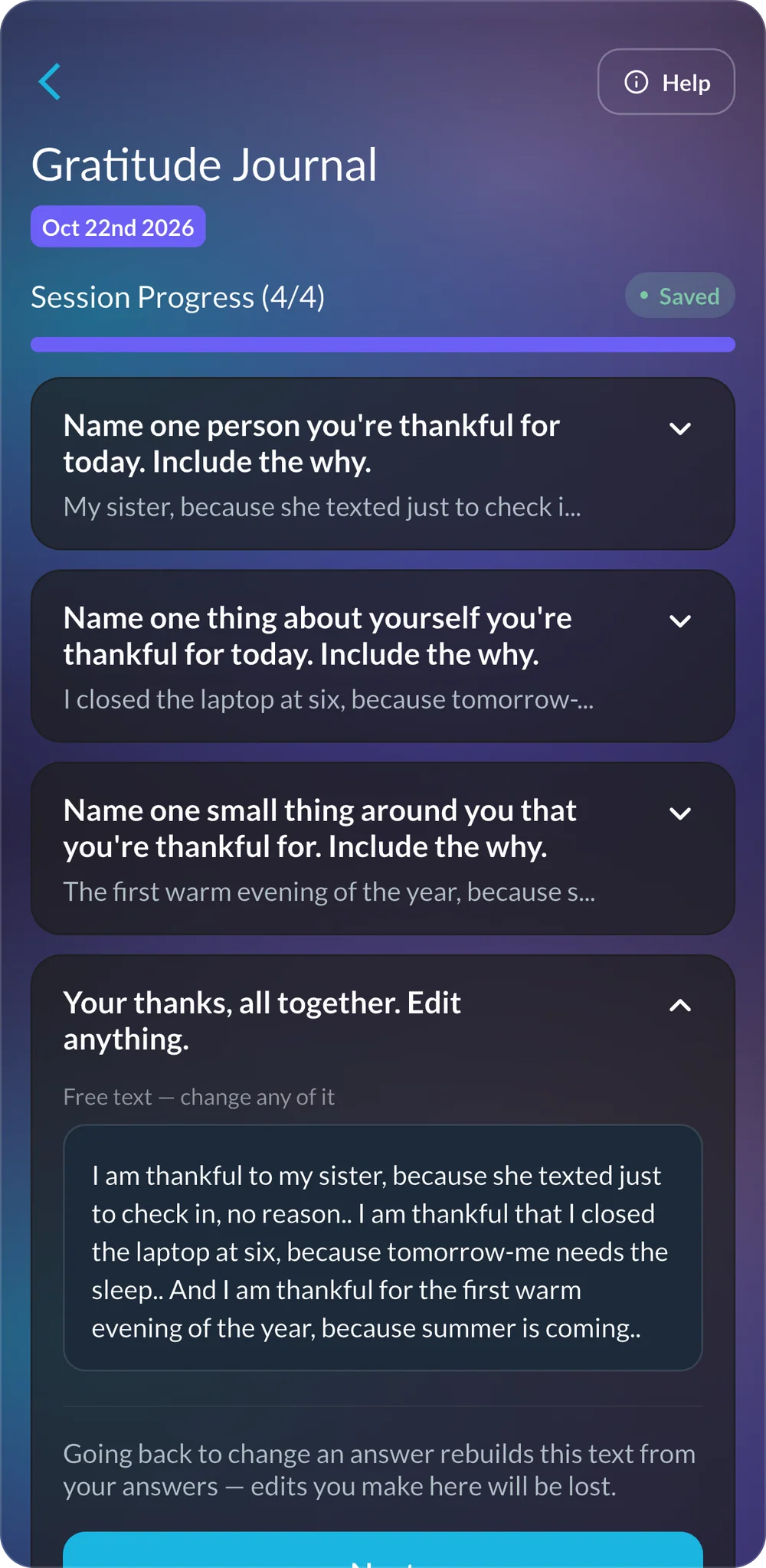
- Name one person you're thankful for today. Include the why.
- Name one thing about yourself you're thankful for today. Include the why.
- Name one small thing around you that you're thankful for. Include the why.
- Read your thanks, all together, and edit anything.
A Gratitude Journal example
A person: my sister, because she texted just to check in, no reason. Yourself: I closed the laptop at six, because tomorrow-me needs the sleep. A small thing: the first warm evening of the year, because summer is coming. All together: "I am thankful to my sister, because she texted just to check in, no reason. I am thankful that I closed the laptop at six, because tomorrow-me needs the sleep. And I am thankful for the first warm evening of the year, because summer is coming."
In Breathtaking the exercise is guided, one question at a time, and the paragraph is assembled from your answers. If journaling is new to you, what journaling is and how it works covers the basics.
What happens when you write it down
Naming what you're thankful for, and why, turns attention toward what's already good, which counters the mind's pull toward what's missing and slowly shifts your baseline toward contentment. The mind is built to scan for problems; three specific reasons at a time retrain it, a little, to scan for the rest. Thanking yourself does a separate job: it is the credit most people never give themselves. You may feel warmth, a softening in the chest, and sometimes a little resistance if the day was hard, all normal here.
What it's used for
A low, flat mood that keeps finding the negative. The end of a day that felt like all problems. A habit of noticing only what is missing. Anyone who is generous with thanks to others and stingy with themselves.
What the research says about the Gratitude Journal
Gratitude journaling has over 20 years of rigorous research (Gratitude and Well Being: The Benefits of Appreciation, Psychiatry, 2010). A review of 64 studies found anxiety decreased by 7.76% and depression by 6.89%. The original studies found people who wrote 5 things they were grateful for weekly exercised more, had fewer physical symptoms, made better progress toward goals, helped others more, and slept better (Counting blessings versus burdens, Emmons and McCullough, 2003). Benefits are stronger when practiced weekly rather than daily.
Where it comes from
It draws on positive psychology research, where regularly naming a few specific good things proved one of the most reliable mood lifts, and spreading the thanks across a person, yourself, and a small thing keeps the practice fresh. Robert Emmons's counting-blessings experiments in 2003 started the research; the evening prayer of thanks for specific blessings is far older, a nightly practice in the Christian and Jewish traditions long before anyone measured it. On the techniques page it sits with the modern methods.
When to use it
The because is what to protect when the entries start to shrink; a reason kept alive keeps the practice alive. The evening, as the last thing before bed. A few times a week rather than every night, which is what the research found works best. On the good days too, so the record is there for the bad ones. It sits next to Joy Amplification, which replays one good moment in full, and the Acknowledgement Ritual, which gives the same honest accounting to a miss.
The Gratitude Journal in Breathtaking
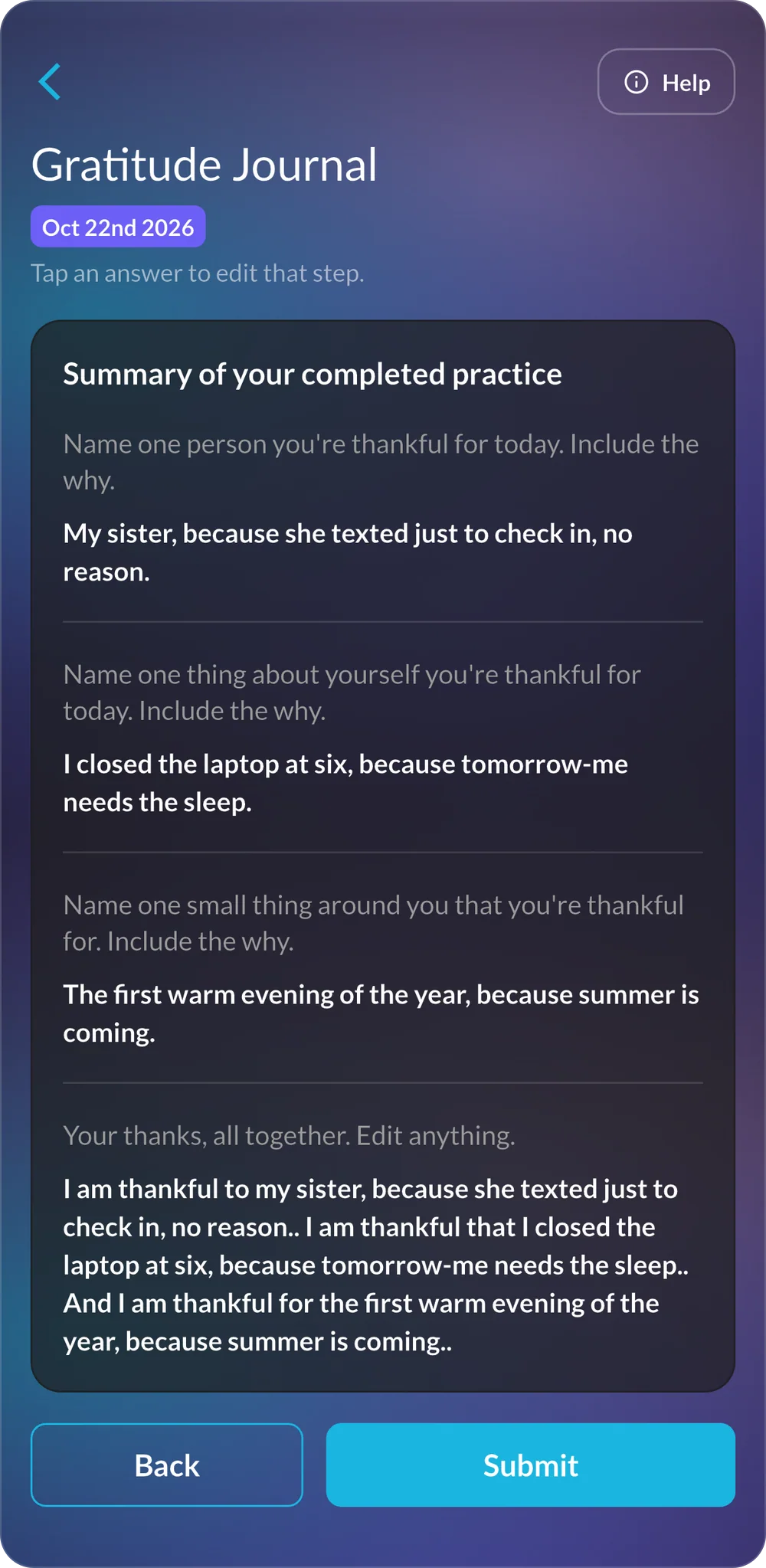
Journaling, self-paced, one question at a time. Calming; its job in the program is compassion. Your entries stay private and are not sent to an outside AI or sold for advertising or any other reason. In the app it is called Gratitude Journal.
Frequently asked questions
How do you start a Gratitude Journal?
Three sentences, each with a because: a person you are thankful for, one thing about yourself, and one small thing around you. Start with the app's prompts and let the reasons get more specific over the weeks.
Does a Gratitude Journal actually work?
In the studies above, gratitude journaling lowered anxiety and depression and improved sleep, exercise and progress toward goals, with the effect stronger for weekly practice than daily.
What should you write in a Gratitude Journal?
A person, something about yourself, and one small thing, each with the reason. Specific beats grand, and the reason is the part that does the work.
Related techniques
Breathtaking Premium gives you unlimited access to the Gratitude Journal and 22 other journaling practices.
These practices are tools for nervous system regulation. The guide explains what it is, the signs you need it, and how to start.
Your personalized program picks one to three of these a day, in the minutes you have.
Try 7 days free