Journaling
Acknowledgement RitualName the miss, take the lesson, drop the guilt
Last updated
What the Acknowledgement Ritual is
A mistake usually gets replayed or buried; this practice does neither. It names the miss plainly, names who felt it and what it cost, and asks what would help next time. Then it hands you a short forgiveness, assembled from your own words: naming it, I'm human, and I forgive myself; I'll carry the lesson, not the guilt. An optional last step asks for one small repair, if one fits. The ritual is in the saying: you read the forgiveness once, make it yours, and say it to yourself.
How to do the Acknowledgement Ritual
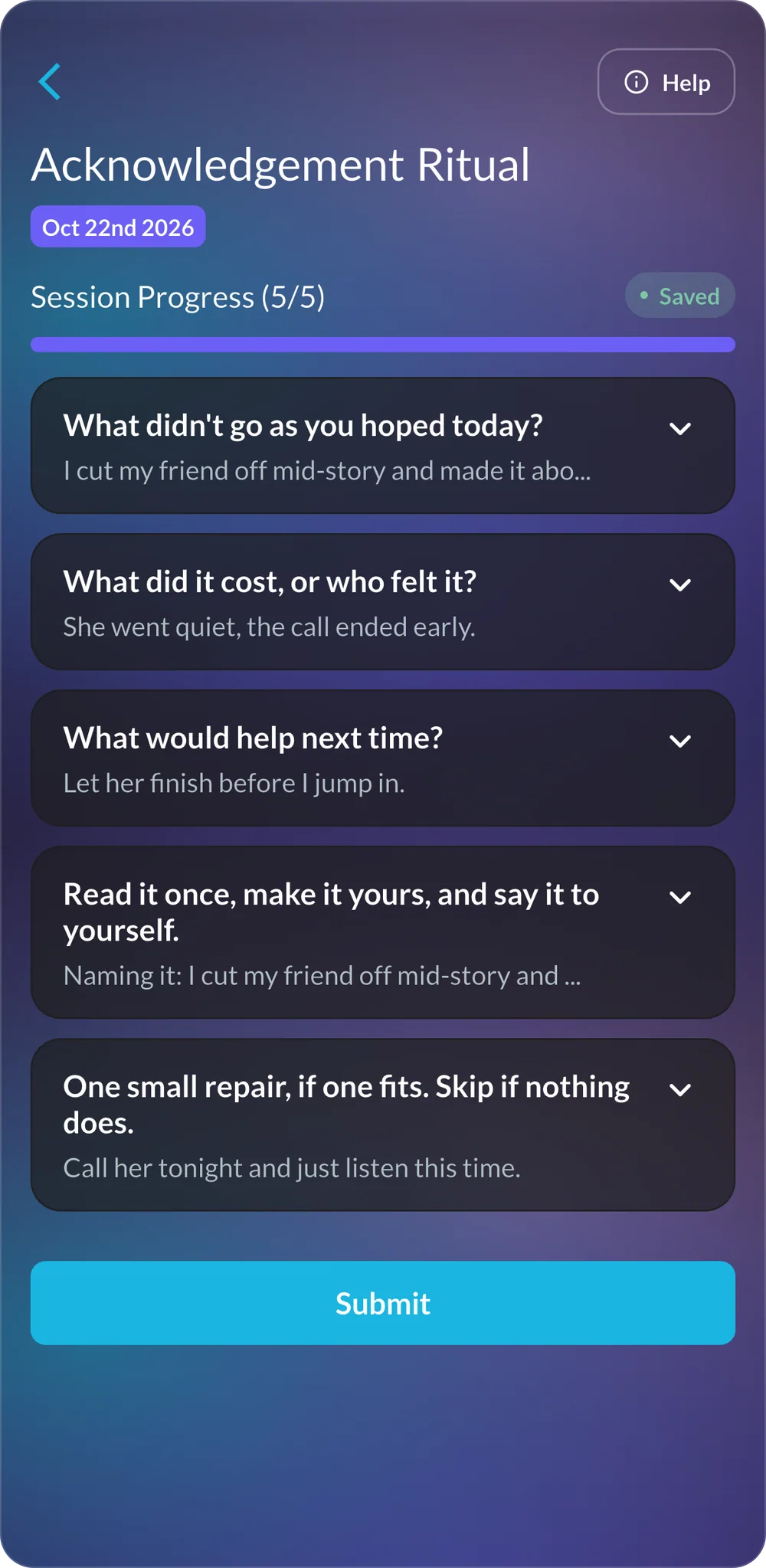
- What didn't go as you hoped today?
- What did it cost, or who felt it?
- What would help next time?
- Read the forgiveness the app assembles from your answers, make it yours, and say it to yourself.
- One small repair, if one fits. Skip if nothing does.
An Acknowledgement Ritual example
The miss: I cut my friend off mid-story and made it about me. The cost: she went quiet, the call ended early. The lesson: let her finish before I jump in. The forgiveness: "Naming it: I cut my friend off mid-story and made it about me. I'm human, and I forgive myself. I'll carry the lesson: let her finish before I jump in. Not the guilt." The repair: call her tonight and just listen this time.
In Breathtaking the exercise is guided, one question at a time, and the forgiveness is built from what you wrote. If journaling is new to you, what journaling is and how it works covers the basics.
What happens when you write it down
Naming a miss in plain words takes it out of the loop where it was being replayed and puts it on the page, where you can see how big it is. Naming the cost keeps the practice honest; naming the lesson makes the cost worth something. Saying the forgiveness, rather than thinking it, is what makes it a ritual, and it counts even when it feels awkward. You may feel a small glow of relief, some awkwardness at forgiving yourself, and a more balanced view of how you're doing.
What it's used for
The evening after a mistake that is still replaying. An inner critic that treats every slip as proof. Perfectionism, which cannot tell a miss from a failure.
Where it comes from
It draws on positive psychology and self-compassion practices that deliberately make room for owning a mistake without punishment, and on the older tradition of the evening review, in which the Stoics and the Ignatians looked at the day's slips with honesty and let them go. The five steps are the miss, the cost, the lesson, the forgiveness and the repair. On the techniques page it sits with the modern methods.
When to use it
The same evening, before the replaying sets in. After any exchange that ended worse than you meant it to. It sits next to the Compassionate Letter, which gives the same kindness more room, and the Stoic Review, which reviews the whole day rather than one miss.
The Acknowledgement Ritual in Breathtaking
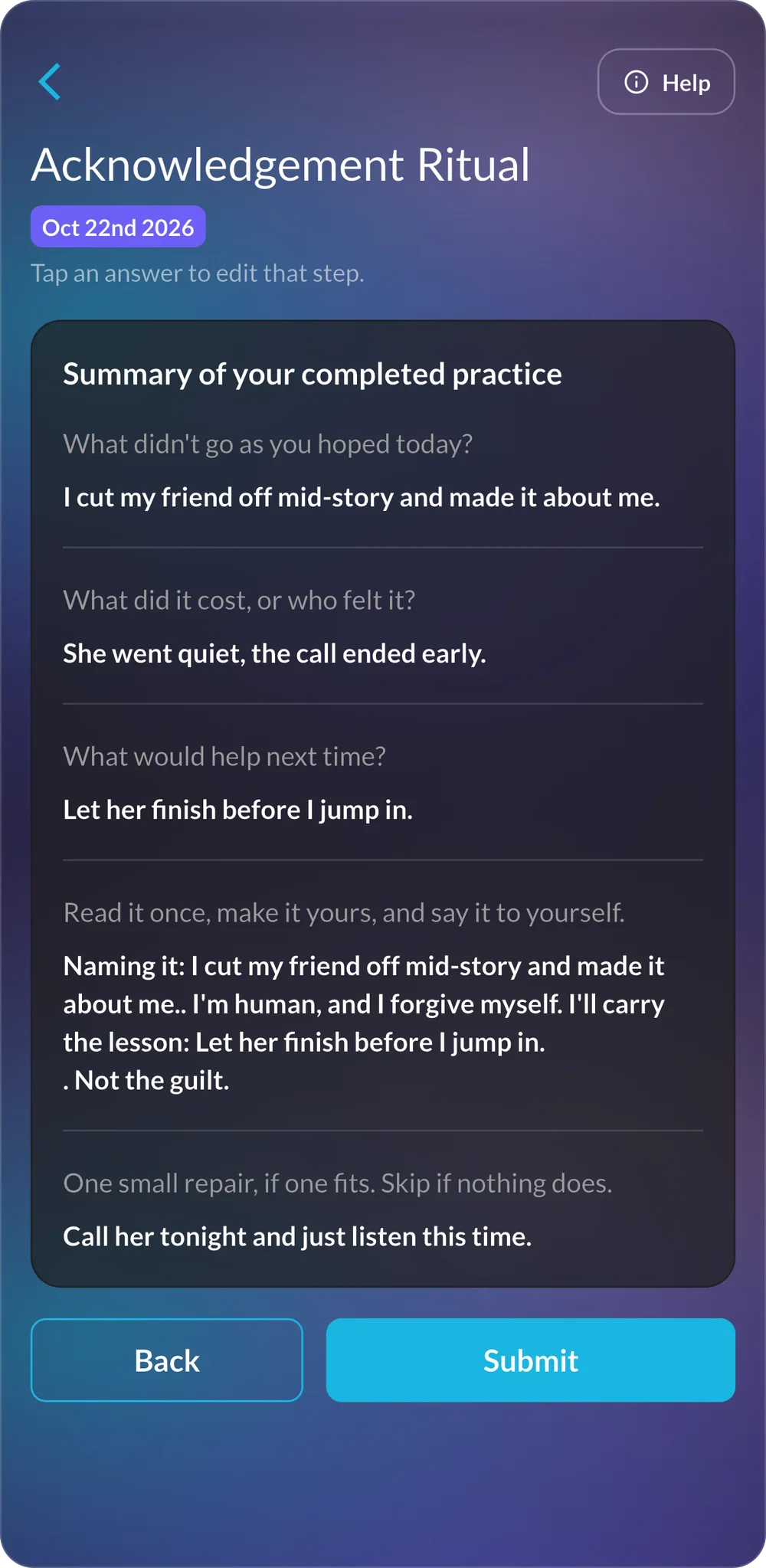
Journaling, self-paced, one question at a time. Its job in the program is compassion. Your entries stay private and are not sent to an outside AI or sold for advertising or any other reason. In the app it is called Acknowledgement Ritual.
Related techniques
Breathtaking Premium gives you unlimited access to the Acknowledgement Ritual and 22 other journaling practices.
These practices are tools for nervous system regulation. The guide explains what it is, the signs you need it, and how to start.
Your personalized program picks one to three of these a day, in the minutes you have.
Try 7 days free