Journaling
Examen JournalingThe day reviewed for what gave energy and what drained it
Last updated
What Examen Journaling is
The daily examen is a five-hundred-year-old evening review, and its modern short form asks two questions: where did you feel most alive today, and where did you feel least. The app's version starts with gratitude, one thing that made you thankful, with the why. Then you list the moments that mattered, good, dull or hard, and pick two. The one that felt most like the real you: what value was alive in it, and what move is worth repeating. The one that felt off: what was missing, and what one kinder move would be next time. It ends with a tweak for tomorrow, written as an if-then. The Ignatian tradition calls the two moments consolation and desolation; the app asks which moment felt most like the real you and which felt off, which is the same map in plainer words.
Examen Journaling vs the Stoic Review
The Stoic Review reviews conduct: what you did well, where you slipped and why. Examen Journaling reviews energy: where you were most yourself and where you were not, which makes it the gentler of the two and the one to start with.
How to do Examen Journaling
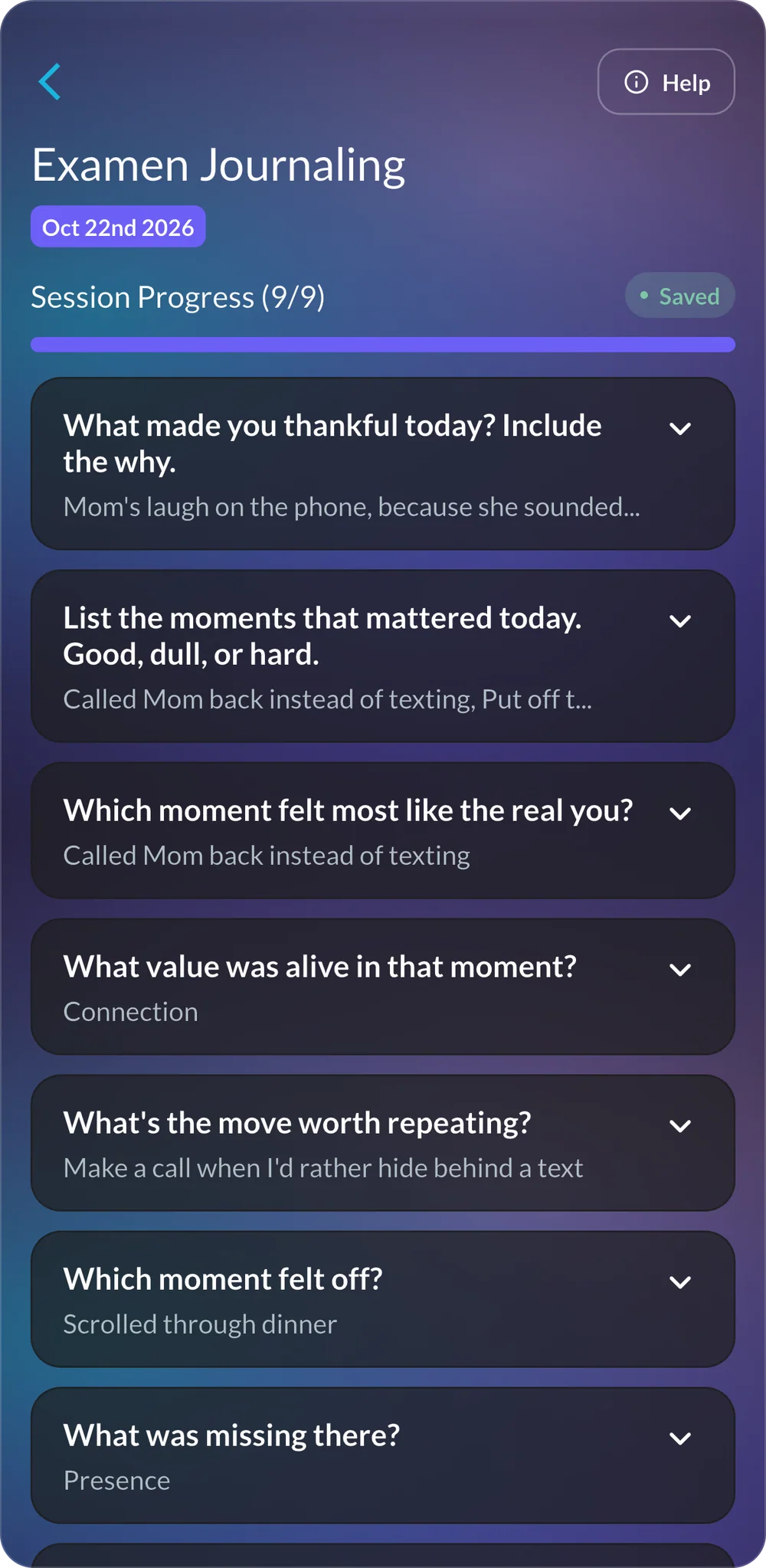
- What made you thankful today? Include the why.
- List the moments that mattered today. Good, dull, or hard.
- Which moment felt most like the real you?
- What value was alive in that moment? Connection, focus, honesty, courage, care, play, learning, rest.
- What's the move worth repeating?
- Which moment felt off?
- What was missing there? Rest, presence, boundaries, focus, honesty, support, patience.
- Next time, what's one kinder move?
- One tweak for tomorrow, as an if-then.
An Examen Journaling example
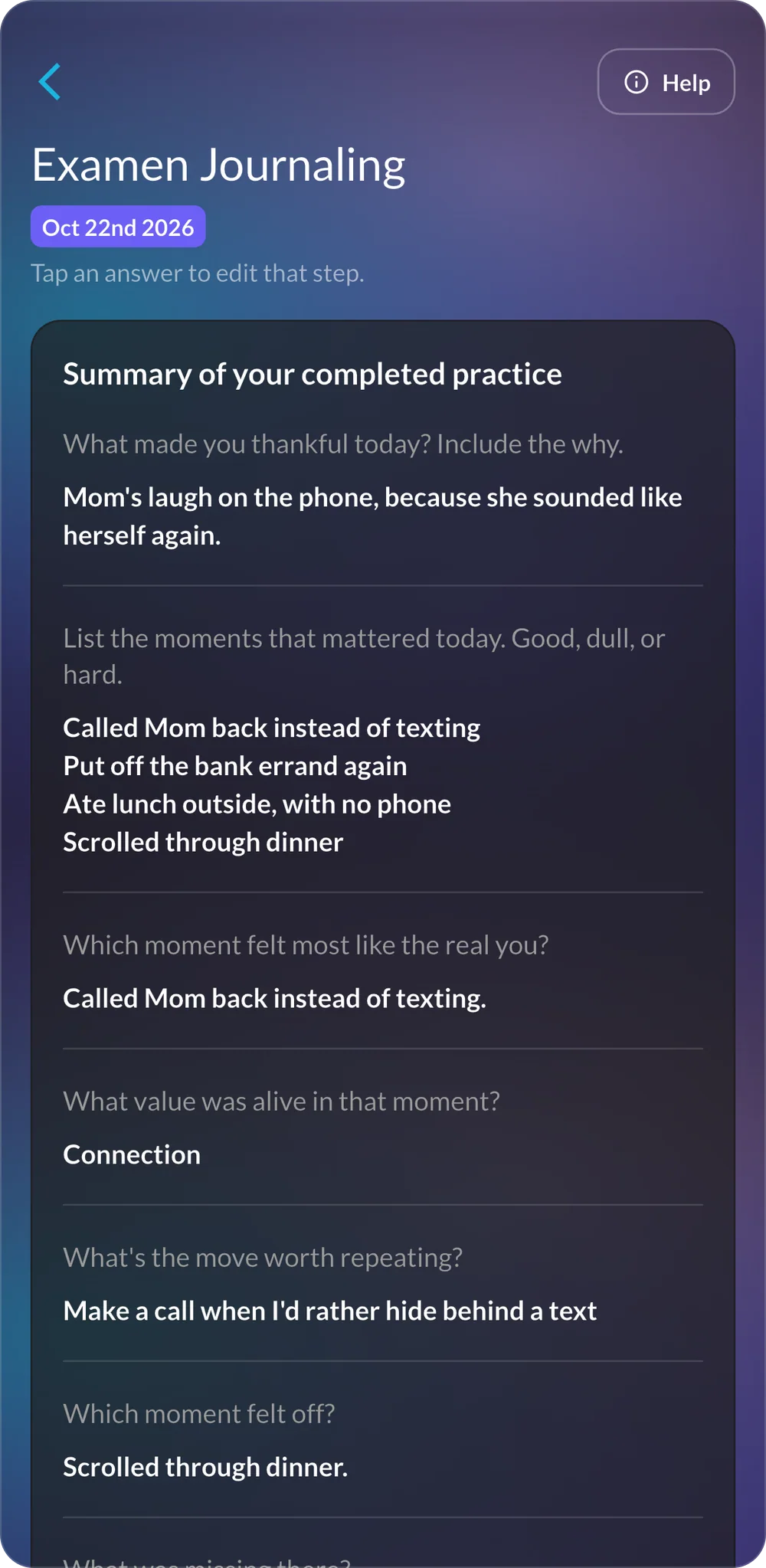
Gratitude: Mom's laugh on the phone, because she sounded like herself again. The moments: called Mom back instead of texting; put off the bank errand again; ate lunch outside, with no phone; scrolled through dinner. Most like me: called Mom back. The value: connection. Worth repeating: make a call when I'd rather hide behind a text. Off: scrolled through dinner. Missing: presence. Kinder move: eat first, scroll after, if I still want to. Tomorrow's tweak: if I reach for my phone at dinner, I'll leave it in another room.
In Breathtaking the exercise is guided, one question at a time, and the two moments are picked by tapping from your own list. If journaling is new to you, what journaling is and how it works covers the basics.
What happens when you write it down
Reviewing the day with attention to what lifted or drained you reveals patterns you'd otherwise miss, building self-knowledge and a gentler, more aware relationship with how you spend your time. Gratitude first sets the tone, so the review looks for what worked before it looks for what did not. Picking a moment that felt like the real you, and naming the value in it, shows you what gives you energy; the off moment, met with a kinder move rather than a verdict, is how it changes tomorrow. You may feel gratitude, some honest recognition of where the day went sideways, and a sense of closure.
What it's used for
An evening reflection that closes the day. Patterns you cannot see from inside the week. Learning what gives you energy and what takes it. A gentler alternative to the harder reviews.
What the research says about Examen Journaling
This 500-year-old Jesuit practice was scientifically tested for the first time in 2023. University students practicing the five-step evening review (presence, gratitude, review, reflect, respond) for just 2 weeks showed increased life satisfaction, greater sense of meaning, and significantly more hope about the future (Plante et al., a study of the secularized Examen with 115 university students, 2024). Over 75% found it worthwhile and would continue the practice.
Where it comes from
The Examen is a centuries-old practice from the Christian Ignatian tradition, here adapted as a secular daily review. Ignatius of Loyola set it down in his Spiritual Exercises as the daily prayer a Jesuit should not skip, and its five steps, presence, gratitude, review, reflect, respond, are the skeleton of the app's nine questions. On the techniques page it sits with the practices of the Christian tradition.
When to use it
The evening, as the last thing. Daily for two weeks to start, which was the length the research used. On the days that felt like a blur, especially; listing the moments brings the day back. It sits next to the Gratitude Journal, which expands the first question into a practice of its own, and the 3 Question Mood Check, the short form for a night with no time for nine.
Examen Journaling in Breathtaking
Journaling, self-paced, one question at a time. Its job in the program is insight, with compassion second. Your entries stay private and are not sent to an outside AI or sold for advertising or any other reason. In the app it is called Examen Journaling.
Frequently asked questions
What are the five steps of the Examen?
Presence, gratitude, review, reflect, respond. Examen Journaling follows the same arc in nine short questions.
What questions does the daily Examen ask?
The two at its heart: where did you feel most alive today, and where did you feel least. The app asks them as which moment felt most like the real you, and which moment felt off, with a value, a move to repeat and a kinder move attached.
Do you have to be religious to do Examen Journaling?
No. The app's version is a secular daily review, and the study above tested a secular form with university students.
Related techniques
Breathtaking Premium gives you unlimited access to Examen Journaling and 22 other journaling practices.
These practices are tools for nervous system regulation. The guide explains what it is, the signs you need it, and how to start.
Your personalized program picks one to three of these a day, in the minutes you have.
Try 7 days free