Journaling
Stoic ReviewWhat went well, where you slipped, and what you will do tomorrow
Last updated
What the Stoic Review is
The Stoic evening review is one of the oldest and simplest practices in the library. Seneca described it: when the lamp is out, he went over his whole day, hid nothing from himself, and passed over nothing. The app's version asks four things. What you did well today. Where you slipped. Why you did it, and the app offers the honest reasons: to avoid an argument, to be liked, to look good, to feel needed, to stay comfortable, to stay in control, to feel safe. What you will do differently tomorrow. Then it assembles the review and closes it with the line that makes it Stoic rather than self-critical: I judged the day fairly, now I can put it down.
The Stoic Review vs Examen Journaling
Examen Journaling reviews the day for what gave energy and what drained it, with gratitude first. The Stoic Review reviews conduct, what you did and why, which makes it the one for character rather than mood.
How to do the Stoic Review
- What did you do well today?
- Where did you slip up today?
- Why did you do it? To avoid an argument, to be liked, to look good, to feel needed, to stay comfortable, to stay in control, to feel safe.
- What will you do differently tomorrow?
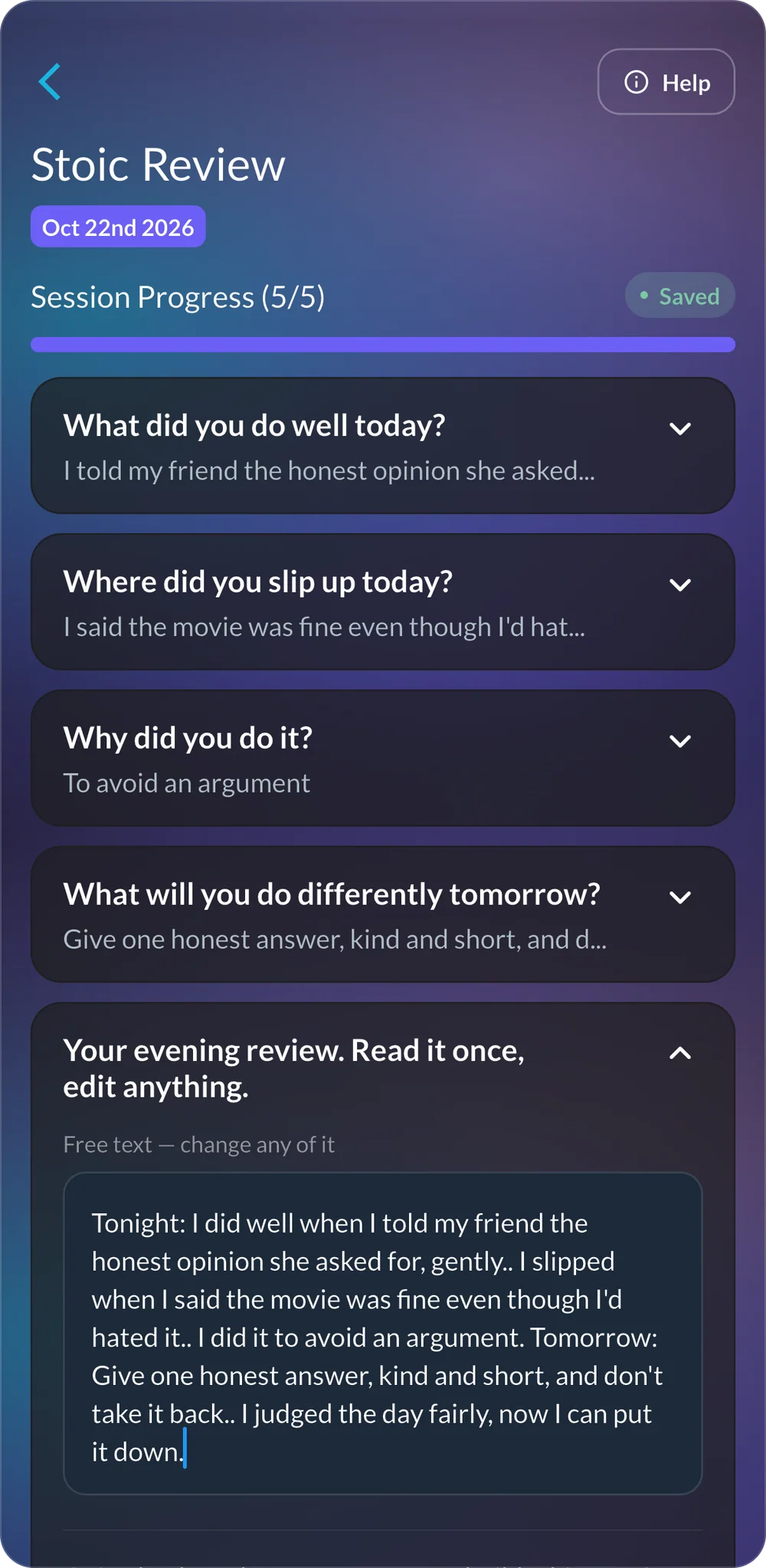
- Read your evening review, assembled from your answers, once, and edit anything.
A Stoic Review example
Did well: I told my friend the honest opinion she asked for, gently. The slip: I said the movie was fine even though I'd hated it. The why: to avoid an argument. Tomorrow: give one honest answer, kind and short, and don't take it back. The review: "Tonight: I did well when I told my friend the honest opinion she asked for, gently. I slipped when I said the movie was fine even though I'd hated it. I did it to avoid an argument. Tomorrow: give one honest answer, kind and short, and don't take it back. I judged the day fairly, now I can put it down."
In Breathtaking the exercise is guided, one question at a time, and the review is assembled from your answers. If journaling is new to you, what journaling is and how it works covers the basics.
What happens when you write it down
Reviewing your conduct without harshness turns each day into practice, reinforcing what aligned with your values and gently correcting what didn't, which compounds into real change over time. Starting with what went well keeps the review fair, and a fair review is one you will act on. Naming the why is the step that changes behavior: a slip with a motive attached is a pattern you can see coming tomorrow. You may feel a steady sense of self-honesty, mild discomfort at a misstep, and a clearer intention for tomorrow.
What it's used for
The change you keep meaning to make and never look at. The same slip, made the same way, for the same reason, every week. An evening routine that closes the day instead of replaying it. Accountability to yourself, without a witness.
What the research says about the Stoic Review
Evening reflection practices from Stoicism were tested in the global Stoic Week program with over 40,000 participants. Results showed life satisfaction increased 14%, negative emotions decreased 15-20%, and positive emotions increased 19% (10 Years of Stoic Week, Aurelius Foundation, 2022). A Birkbeck University study found 18% reduction in rumination (repetitive negative thinking) and 15% improvement in self-efficacy after just 8 days of practice (Birkbeck study on Stoicism and its impact on mental health, Birkbeck University, 2020).
Where it comes from
Evening self-review was a daily practice of the Stoics, described by Seneca and Marcus Aurelius as a way to refine character. Seneca learned it from the philosopher Sextius; the Pythagoreans before them asked three questions each night: where did I go wrong, what did I do, what duty was left undone. On the techniques page it sits with the practices of the Stoic tradition.
When to use it
The evening, as the last thing, when the lamp is out. Daily, so the small corrections add up. It sits next to Stoic Premeditation, its morning mirror, and the Acknowledgement Ritual, for the days one slip needs more room than a review gives it, with a forgiveness at the end.
The Stoic Review in Breathtaking
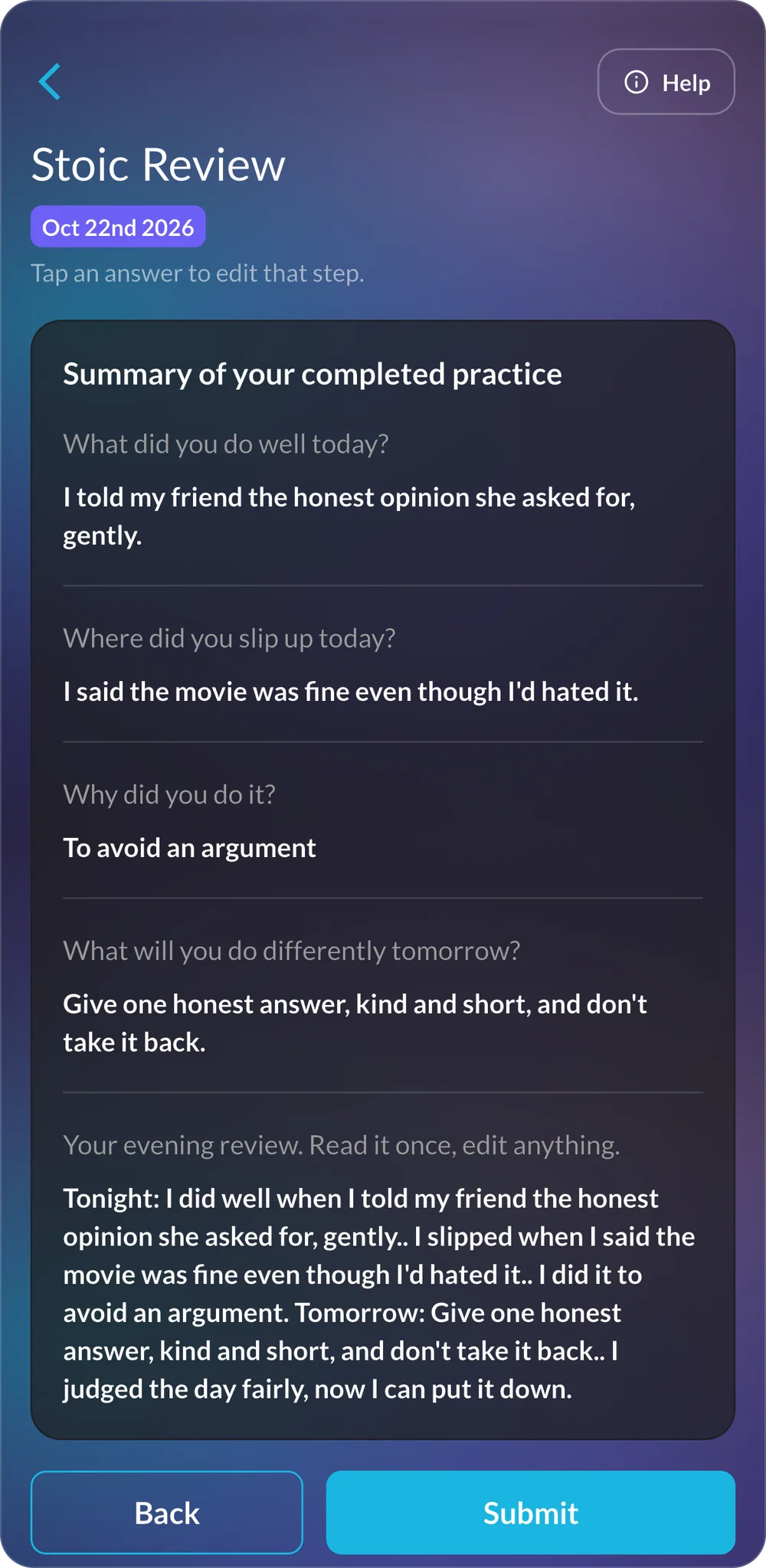
Journaling, self-paced, one question at a time. Its job in the program is insight. Your entries stay private and are not sent to an outside AI or sold for advertising or any other reason. In the app it is called Stoic Review.
Frequently asked questions
What is the Stoic evening review?
A nightly written review of the day's conduct: what went well, where you slipped, why, and what you will do differently tomorrow. Seneca did it every night when the lamp went out.
What questions does the Stoic Review ask?
Four: what did you do well today, where did you slip up, why did you do it, and what will you do differently tomorrow. The assembled review ends with the line that keeps it fair: I judged the day fairly, now I can put it down.
Is the Stoic Review just self-criticism?
No; the Stoic Review starts with what went well and ends by putting the day down. The slip is looked at for its motive, so tomorrow can go differently, and then it is released.
Related techniques
- Stoic PremeditationPicturing the day's obstacles and how you'll meet them with composure, to steady yourself.
- Examen JournalingYour day reviewed for what gave energy and what drained it, to learn from it.
- Acknowledgement RitualNaming what you did well and giving yourself credit, to quiet the inner critic.
Breathtaking Premium gives you unlimited access to the Stoic Review and 22 other journaling practices.
These practices are tools for nervous system regulation. The guide explains what it is, the signs you need it, and how to start.
Your personalized program picks one to three of these a day, in the minutes you have.
Try 7 days free