Journaling
3 Question Mood CheckName the feeling, its cause, and one helpful line
Last updated
What the 3 Question Mood Check is
Three questions, in order. What: pick a family of feeling, angry, sad, worried, disgusted, joyful, connected, tired or flat, then the precise word inside it, resentful rather than angry, foggy rather than tired. Why: what likely led to this, in a line. What's next: one helpful line written to yourself, and the app offers a shape for it that fits the feeling you picked, a fair line to draw if you are angry, one thing you know for sure if you are worried, one thing to savor if you are joyful. The point is precision: a feeling with an exact name and a likely cause is easier to carry than a vague bad mood.
How to do the 3 Question Mood Check
- Pick a family, then a precise word.
- What likely led to this?
- Write yourself one helpful line.
A 3 Question Mood Check example
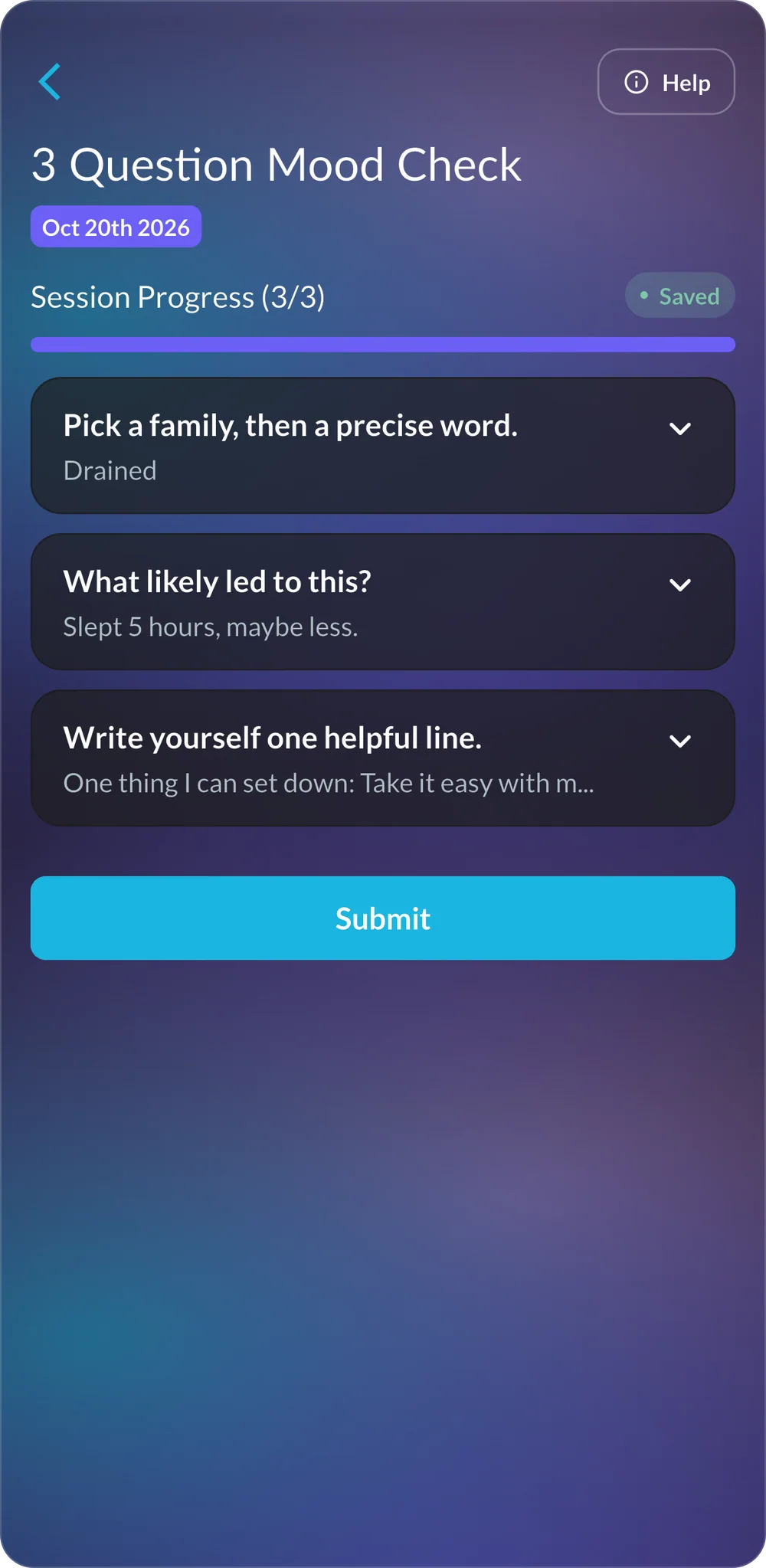
Pick a family, then a precise word: tired, drained. What likely led to this: slept 5 hours, maybe less. One helpful line: one thing I can set down: take it easy with myself today, I don't have to be super productive every day.
In Breathtaking the check is guided, one question at a time, and the third question's examples change with the feeling you picked. If journaling is new to you, what journaling is and how it works covers the basics.
What happens when you write it down
Putting feelings into words, sometimes called affect labeling, takes some of the charge out of them and helps you see your state more objectively instead of being inside it. Naming a likely cause turns a mood into an event with a beginning, and the helpful line turns it into something you can do something about. You may notice clarity, a small sense of relief, or surprise at what surfaces when you actually name it.
What it's used for
A daily check-in, the same time each day. The moment you notice a mood and cannot say what it is. The minute before a conversation, so the feeling does not run it.
What the research says about the 3 Question Mood Check
Regular emotion tracking using simple rating scales improves "emotional granularity", your ability to identify specific feelings rather than vague moods. A 2022 study found that labeling intense emotions reduced distress significantly, though interestingly, labeling mild emotions actually increased distress (Affect labeling: The role of timing and intensity, Emotion, 2022). Research with 50 adults doing mood checks 8+ times daily for two weeks showed both positive and negative emotion recognition improved with practice (Emotional Granularity Increases With Intensive Ambulatory Assessment, Frontiers in Psychology, 2021).
Where it comes from
It draws on reflective journaling and mood-tracking approaches used in modern therapy and self-monitoring, where naming a feeling and its trigger is usually the first step. On the techniques page it sits with the modern methods.
When to use it
Morning or evening, daily, as the check that keeps you in touch with yourself. Any time a mood arrives without a name. It sits next to the Emotion Wheel, which goes deeper into the naming, and the CBT Thought Log, which takes over when the feeling has a thought behind it worth examining.
The 3 Question Mood Check in Breathtaking
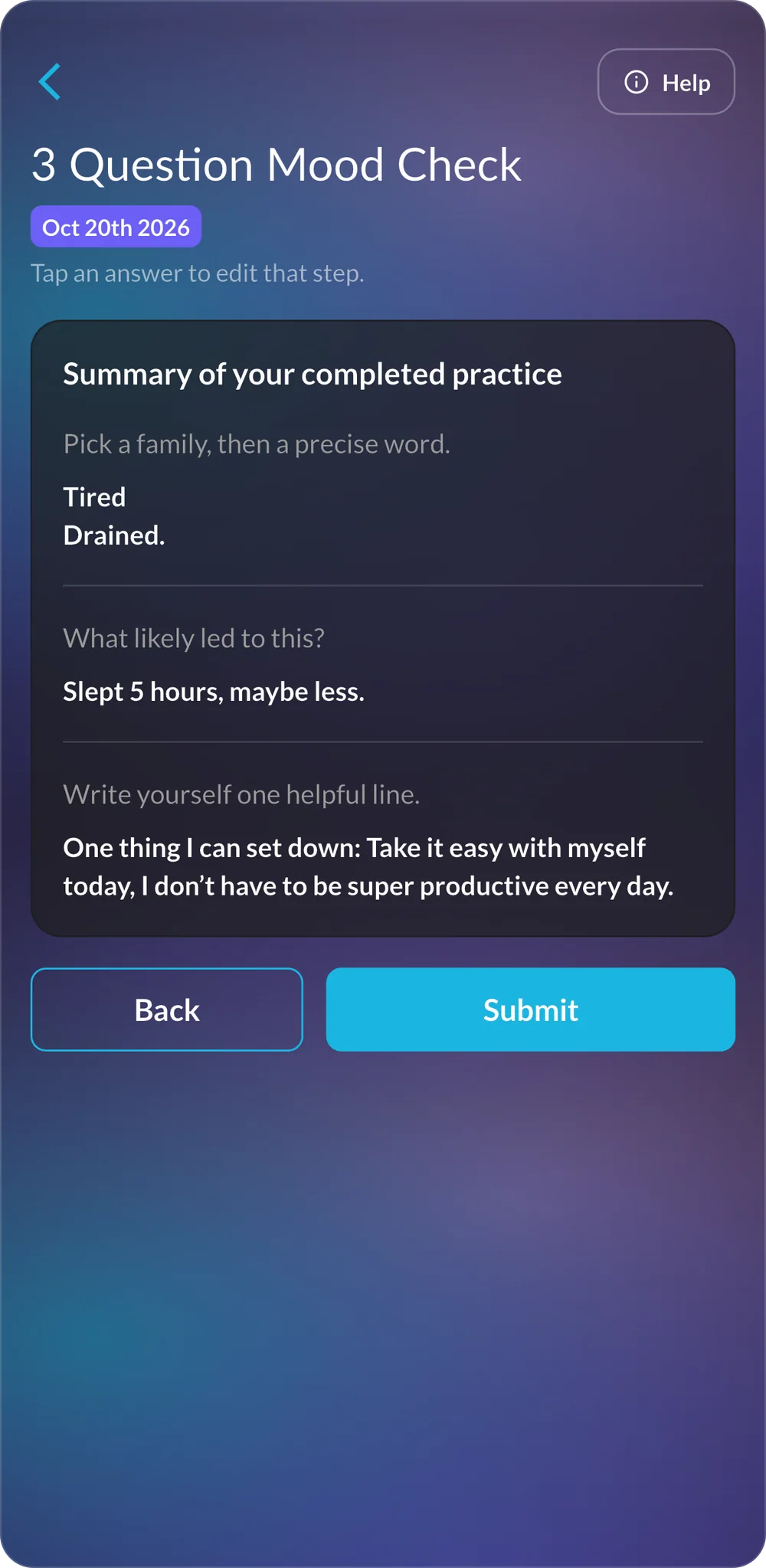
Journaling, self-paced, one question at a time. Its job in the program is insight, with defusion second. Your entries stay private and are not sent to an outside AI or sold for advertising or any other reason. In the app it is called 3 Question Mood Check.
Related techniques
Breathtaking Premium gives you unlimited access to the 3 Question Mood Check and 22 other journaling practices.
These practices are tools for nervous system regulation. The guide explains what it is, the signs you need it, and how to start.
Your personalized program picks one to three of these a day, in the minutes you have.
Try 7 days free