Journaling
Compassionate LetterA letter to yourself about a struggle, written with warmth
Last updated
What the Compassionate Letter is
A self-compassion letter has a shape, and the shape is what makes it work when the warmth does not come naturally. You name one thing you have been hard on yourself about, small is fine. You start kindly: what is hard about it, and what you feel. You remind yourself that others struggle with this too, because they do. You close with a kind wish for yourself, and, if you want one, a line to carry into the day. It is the same letter you would write to a friend in the same spot, addressed to you, and the awkwardness of that is part of the exercise.
The Compassionate Letter vs self-compassion meditation
Self-compassion meditation does the same three moves in the mind. The letter does them on paper, slower, which lets the kindness be more specific and gives you something to reread.
How to do the Compassionate Letter
Because it brings a tender struggle into focus, give yourself a settled moment before you begin.
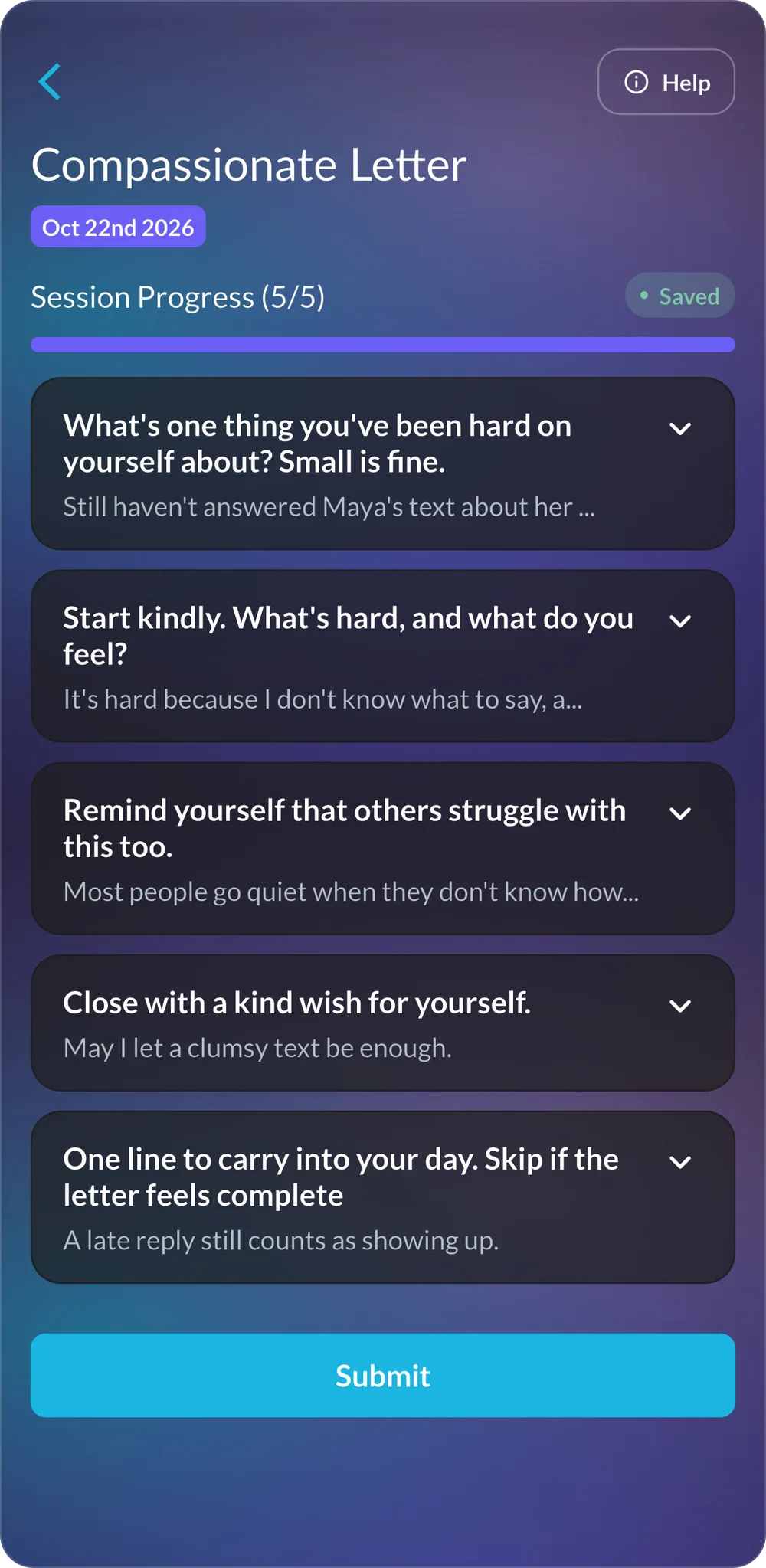
- What's one thing you've been hard on yourself about? Small is fine.
- Start kindly. What's hard, and what do you feel?
- Remind yourself that others struggle with this too.
- Close with a kind wish for yourself.
- One line to carry into your day. Skip if the letter feels complete.
A Compassionate Letter example
The focus: still haven't answered Maya's text about her mom. Acknowledge: it's hard because I don't know what to say, and the longer I wait the more ashamed I feel. Not alone: most people go quiet when they don't know how to help; it doesn't mean I don't care. Kind wish: may I let a clumsy text be enough. Carry line: a late reply still counts as showing up.
In Breathtaking the exercise is guided, one question at a time. If journaling is new to you, what journaling is and how it works covers the basics.
What happens when you write it down
Writing to yourself with the warmth you'd give someone you love shifts you out of self-criticism and activates the body's soothing system, which eases shame and builds a kinder inner voice. Self-criticism runs on the threat system; a kind voice, even your own, signals safety. The not-alone step does something specific: shame depends on feeling singular. You may feel resistance or sadness at first, then warmth and relief as the kindness lands.
What it's used for
Self-criticism that has become the default voice. Shame about something small that has grown in the dark. A hard moment you have been carrying alone. Anyone who is kinder to everyone else than to themselves.
What the research says about the Compassionate Letter
Writing self-compassionate letters for 14 days produced dramatic results in a 2023 study with highly self-critical individuals. Global shame showed medium-large effect size reduction (d = 0.76), external shame showed large effect size reduction (d = 0.83), and improvements in self-criticism, anxiety, and depression lasted at least one month (A Brief Self-Compassionate Letter-Writing Intervention for Individuals with High Shame, Mindfulness, 2023). The practice involves writing to yourself with the same kindness you'd show a good friend facing similar struggles.
Where it comes from
It draws on self-compassion research and a long tradition of letter-writing as a tool for reflection and healing. Kristin Neff made the letter to yourself one of the core exercises of her work in the 2000s, and Paul Gilbert's compassion-focused therapy uses the same form; the three-part shape, acknowledge, not alone, kind wish, follows Neff's three components of self-compassion. On the techniques page it sits with the modern methods.
When to use it
The evening of a hard day, when the critic is loudest. Once a week for a month if the critic is always there. Reread the letters; a meditation leaves nothing to reread. It sits next to the Acknowledgement Ritual, the shorter form for a single miss, and the IFS Protector Journal, which turns toward the critic itself.
The Compassionate Letter in Breathtaking
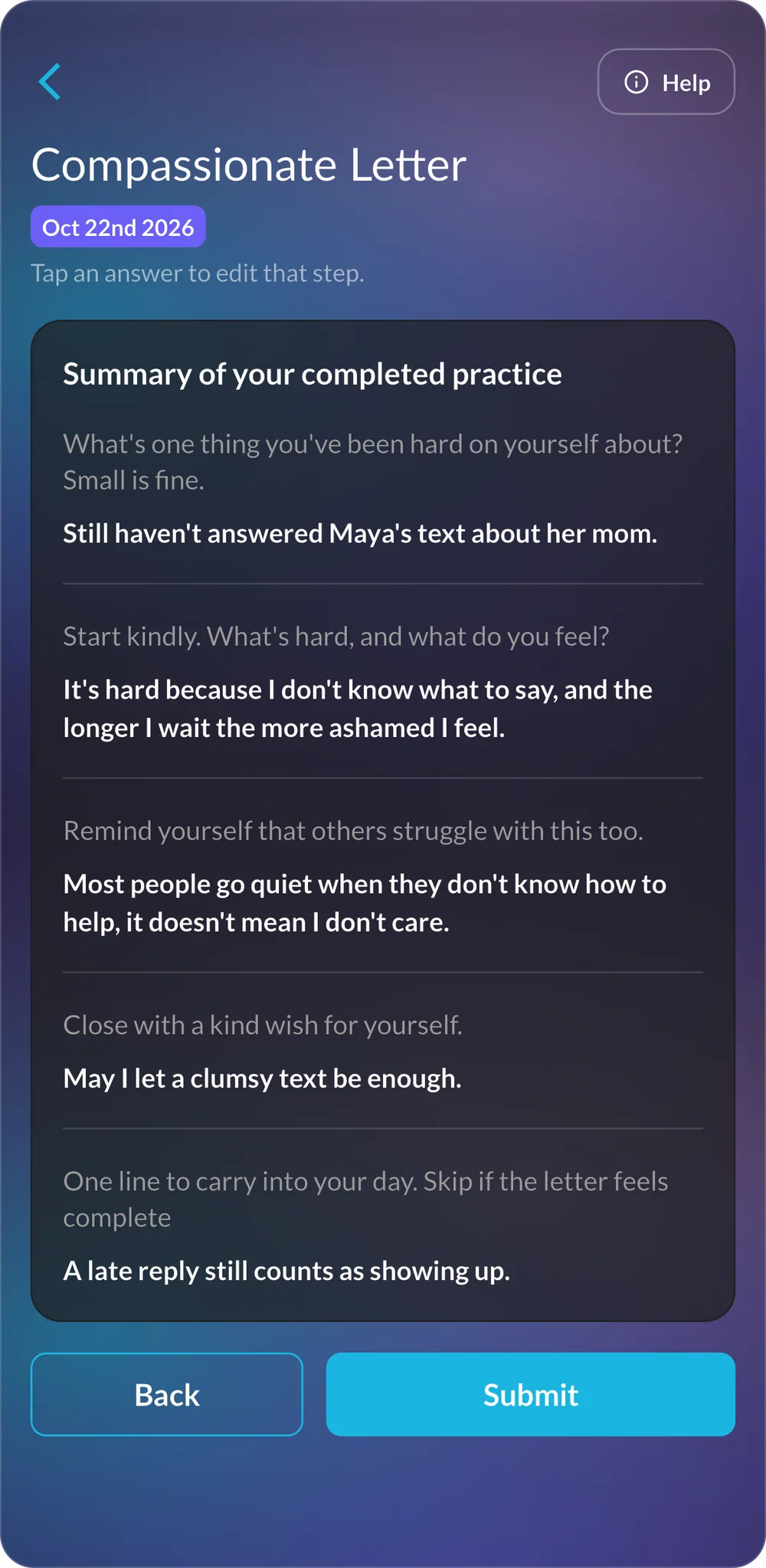
Journaling, self-paced, one question at a time. Calming; its job in the program is compassion, with defusion second. Your entries stay private and are not sent to an outside AI or sold for advertising or any other reason. In the app it is called Compassionate Letter.
Frequently asked questions
How do you write a compassionate letter to yourself?
Name one thing you have been hard on yourself about, write what is hard and what you feel, remind yourself that others struggle with it too, and close with a kind wish. Write as you would to a friend in the same place.
What are the three pillars of self-compassion?
Mindfulness, noticing the pain without drowning in it; common humanity, remembering that struggle is part of being a person; and self-kindness, responding with warmth instead of criticism. The Compassionate Letter walks through them in that order.
What is an example of a self-compassionate statement?
"It's hard to keep promises to myself this tired, and anyone this stretched would struggle; may I start small tomorrow, and let that count." A self-compassion letter is a few of those in a row, about one real thing.
Related techniques
- Self Compassion MeditationTurning warmth and understanding toward yourself in a hard moment, to soften self-talk.
- Acknowledgement RitualNaming what you did well and giving yourself credit, to quiet the inner critic.
- IFS Protector JournalGetting to know an inner critic or procrastinating part with curiosity, to ease the conflict.
Breathtaking Premium gives you unlimited access to the Compassionate Letter and 22 other journaling practices.
These practices are tools for nervous system regulation. The guide explains what it is, the signs you need it, and how to start.
Your personalized program picks one to three of these a day, in the minutes you have.
Try 7 days free