Journaling
IFS Protector JournalGetting to know the part of you that took over
Last updated
What the IFS Protector Journal is
Internal Family Systems, IFS, maps the mind as a system of parts around a core self, and its most useful idea is that the parts that cause trouble, the perfectionist, the pleaser, the scroller, the inner critic, are protectors. Each one is trying to keep you safe from something: failure, rejection, shame, chaos. IFS journaling turns toward one of them on paper. You name the part that took over today, thank it, ask what it is protecting you from and what would help it relax, and offer it one small thing. The app assembles the answers into a short story of the part, in your own words. Nothing is fought; the part is met.
The IFS Protector Journal vs the CBT Thought Log
The CBT Thought Log examines a thought for accuracy. The IFS Protector Journal asks who is thinking it and what they are afraid of, which is the question to ask when a thought keeps winning the argument.
How to do the IFS Protector Journal
Because it invites you into tender inner territory, take a settled moment before you begin.
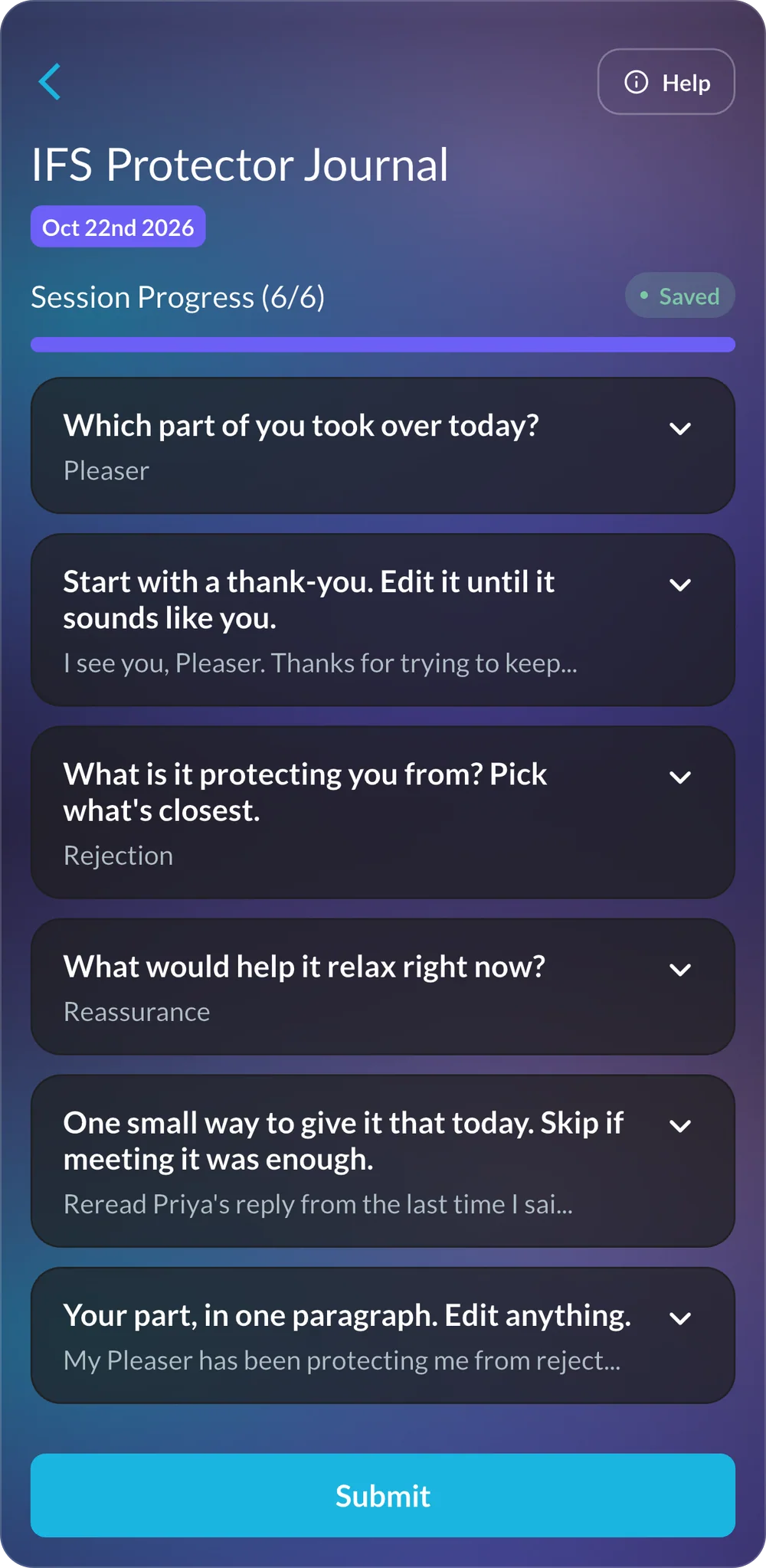
- Which part of you took over today? Perfectionist, procrastinator, pleaser, inner critic, over-worker, scroller, controller, overthinker.
- Start with a thank-you: "I see you. Thanks for trying to keep me safe." Edit it until it sounds like you.
- What is it protecting you from? Failure, rejection, conflict, shame, loss, chaos, uncertainty, boredom, pain.
- What would help it relax right now? Reassurance, a clear plan, a rest break, boundaries, kind words, help from someone, a simpler step, permission to stop.
- One small way to give it that today. Skip if meeting it was enough.
- Read your part's story, assembled from your answers, and edit anything.
An IFS Protector Journal example
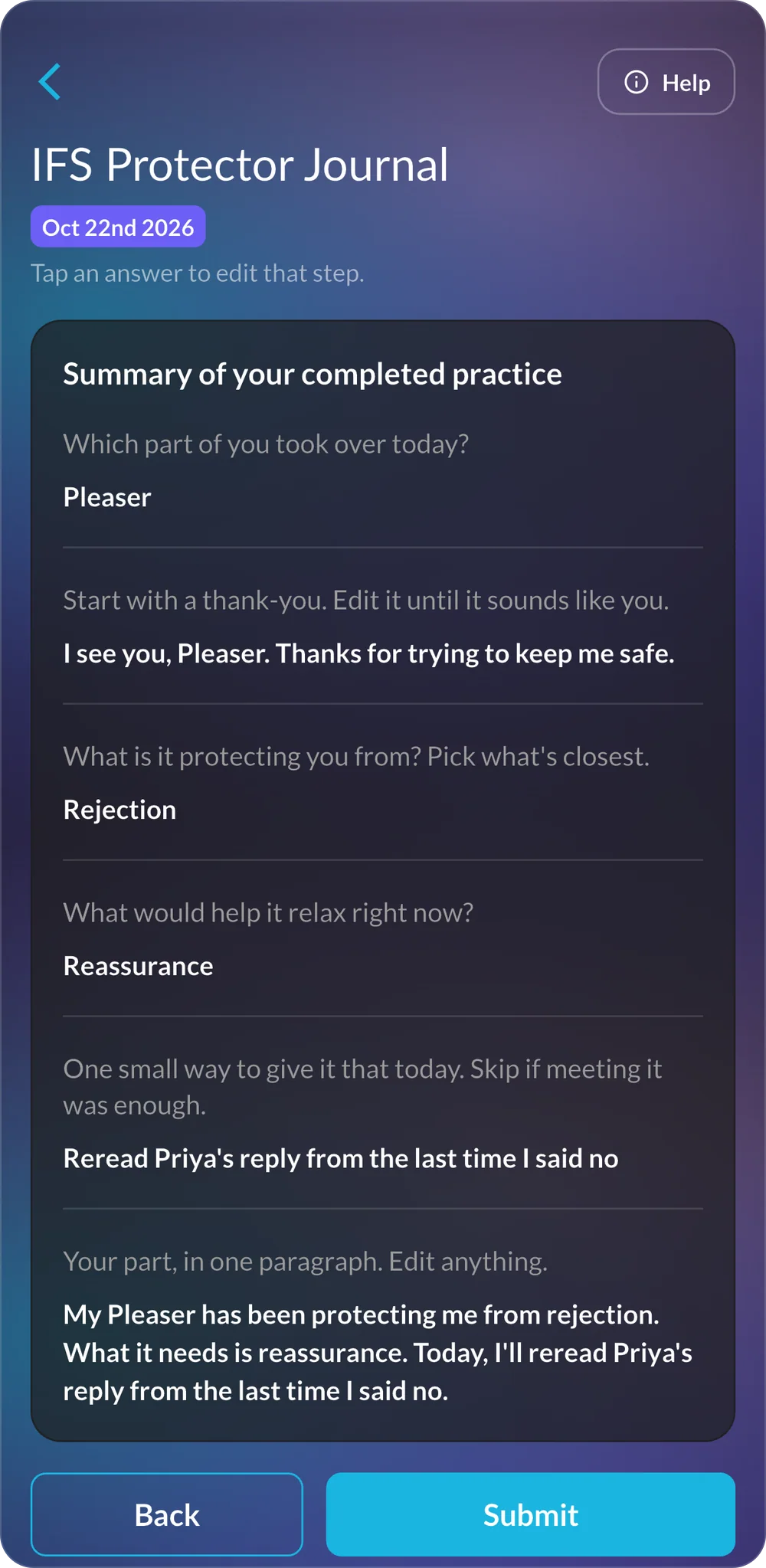
The part: pleaser. The thank-you: I see you, Pleaser. Thanks for trying to keep me safe. Its fear: rejection. Its need: reassurance. Tiny step: reread Priya's reply from the last time I said no. The story: "My Pleaser has been protecting me from rejection. What it needs is reassurance. Today, I'll reread Priya's reply from the last time I said no."
In Breathtaking the exercise is guided, one question at a time, with the parts, fears and needs offered as choices. If journaling is new to you, what journaling is and how it works covers the basics.
What happens when you write it down
Treating a harsh or stuck pattern as a part with a protective intention, rather than a flaw, lowers the inner conflict and lets you relate to it with curiosity, which softens its grip. A part that is fought digs in; a part that is thanked and asked what it needs usually has an answer. Writing the story as "my Pleaser has been protecting me" creates the distance IFS calls unblending: you are the one looking, not the part. You may feel resistance, surprise at a part's hidden intention, or unexpected tenderness toward yourself.
What it's used for
An inner critic that will not be argued with. Procrastination, perfectionism and people-pleasing, the classic protectors. Self-sabotage you can see and cannot stop. The moment you notice a part has taken the wheel.
What the research says about the IFS Protector Journal
Internal Family Systems journaling about your internal "parts" showed extraordinary results for trauma survivors. A study with 17 adults found PTSD symptoms decreased with one of the largest effect sizes ever recorded in trauma research (Internal Family Systems Therapy for PTSD among Survivors of Multiple Childhood Trauma: A Pilot Effectiveness Study, Journal of Aggression, Maltreatment and Trauma, 2021). Participants also showed significant improvements in depression, body awareness, and self-compassion after 16 sessions. In a randomized controlled trial in the Journal of Rheumatology, 2013, an IFS-based program improved pain, physical function and depressive symptoms in people with rheumatoid arthritis.
Where it comes from
IFS was developed by therapist Richard Schwartz, who mapped the mind as a system of parts around a core self, in the 1980s, after noticing that his clients described their inner lives in exactly those terms. Protectors, exiles and the self are his vocabulary; the journal asks a part the questions an IFS session asks, on paper. On the techniques page it sits with the modern methods.
When to use it
The evening of a day when a part took over. Weekly with the same part until its story starts to change. Before a task the procrastinator or the perfectionist is guarding. It sits next to the Compassionate Letter, the same warmth addressed to the whole of you, and the Emotion Wheel, which helps name what the part is feeling.
The IFS Protector Journal in Breathtaking
Journaling, self-paced, one question at a time. Its job in the program is compassion, with defusion second. Your entries stay private and are not sent to an outside AI or sold for advertising or any other reason. In the app it is called IFS Protector Journal.
Frequently asked questions
What are the common protector parts in IFS?
The inner critic, the perfectionist, the pleaser, the procrastinator, the controller, the over-worker, the overthinker and, lately, the scroller. Each protects against something, usually failure, rejection, shame or chaos.
What do protectors do in IFS?
They keep you away from pain by managing your behavior in advance, the critic by pushing, the procrastinator by avoiding, the pleaser by smoothing. The IFS Protector Journal asks each one what it is protecting you from and what it needs instead.
Can you do the IFS Protector Journal on your own?
Yes; IFS journaling with the everyday protectors, the critic, the procrastinator, the pleaser, is what this practice is for. The journal stays with the protector and what it needs, which is the part of the work that fits on a page.
Related techniques
Breathtaking Premium gives you unlimited access to the IFS Protector Journal and 22 other journaling practices.
These practices are tools for nervous system regulation. The guide explains what it is, the signs you need it, and how to start.
Your personalized program picks one to three of these a day, in the minutes you have.
Try 7 days free