Journaling
Accountability Buddy CallA goal, a next step, and someone to tell
Last updated
What the Accountability Buddy Call is
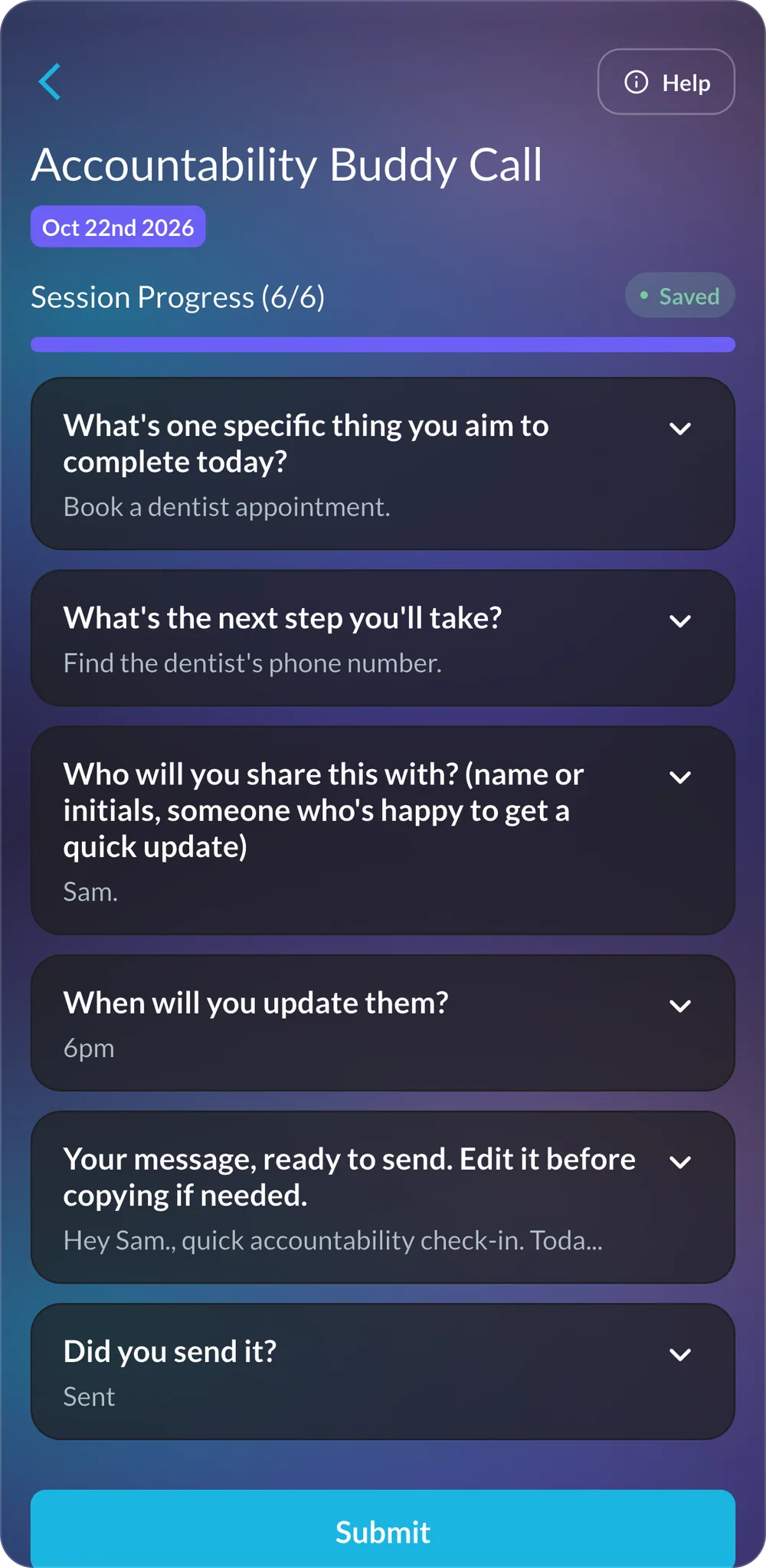
A private intention is easy to drop. The same intention, told to a person who will ask about it, is a different thing, and this practice is the few lines that turn one into the other. You name one specific thing to complete today, the tiny first step, the person you will tell, and when you will update them. The app assembles those into a short message, ready to send, and asks one last question: did you send it?
How to do the Accountability Buddy Call
- What's one specific thing you aim to complete today?
- What's the next step you'll take?
- Who will you share this with? A name or initials, someone who is happy to get a quick update.
- When will you update them?
- Read the assembled message, edit it until it sounds like you, and copy it.
- Did you send it?
An Accountability Buddy Call example
Today's goal: book a dentist appointment. Next step: find the dentist's phone number. Buddy: Sam. Update time: 6pm. The message: "Hey Sam, quick accountability check-in. Today's goal: book a dentist appointment. First step: find the dentist's phone number. I'll update you by 6pm. Thanks for being my accountability buddy!" Sent.
In Breathtaking the exercise is guided, one question at a time, and the message is assembled from your answers. If journaling is new to you, what journaling is and how it works covers the basics.
What happens when you write it down
Telling someone else what you intend to do adds social commitment, which makes you more likely to follow through than a private intention. Writing the goal in one specific line, with a first step small enough to do in a minute, removes the vagueness that procrastination lives in. Naming an update time gives the day a deadline that someone else is holding. You may feel a bit more on the hook in a good way, with a clearer sense of commitment.
What it's used for
The task you have been avoiding for weeks. A habit you keep starting alone. A day that needs one thing to actually happen.
What the research says about the Accountability Buddy Call
A landmark study with 267 participants found that people who sent weekly progress reports to a friend achieved significantly more goals (scoring 7.6 out of 10) compared to those who kept goals to themselves (scoring 4.3 out of 10) (Dr. Gail Matthews's Dominican University study on goal achievement, 2007). Having an accountability partner has been shown to create a 95% success rate when you commit to specific check-in times. The practice works by creating social commitment and external structure for behavior change.
Where it comes from
It draws on behavioral science around commitment and accountability, widely used in coaching and habit-building. On the techniques page it sits with the modern methods.
When to use it
The morning, for the one thing today needs. Any day the goal has slipped three times running. It sits next to WOOP, which plans for the obstacle inside you, and Pomodoro Start, which gets the first block of work started once the promise is made.
The Accountability Buddy Call in Breathtaking
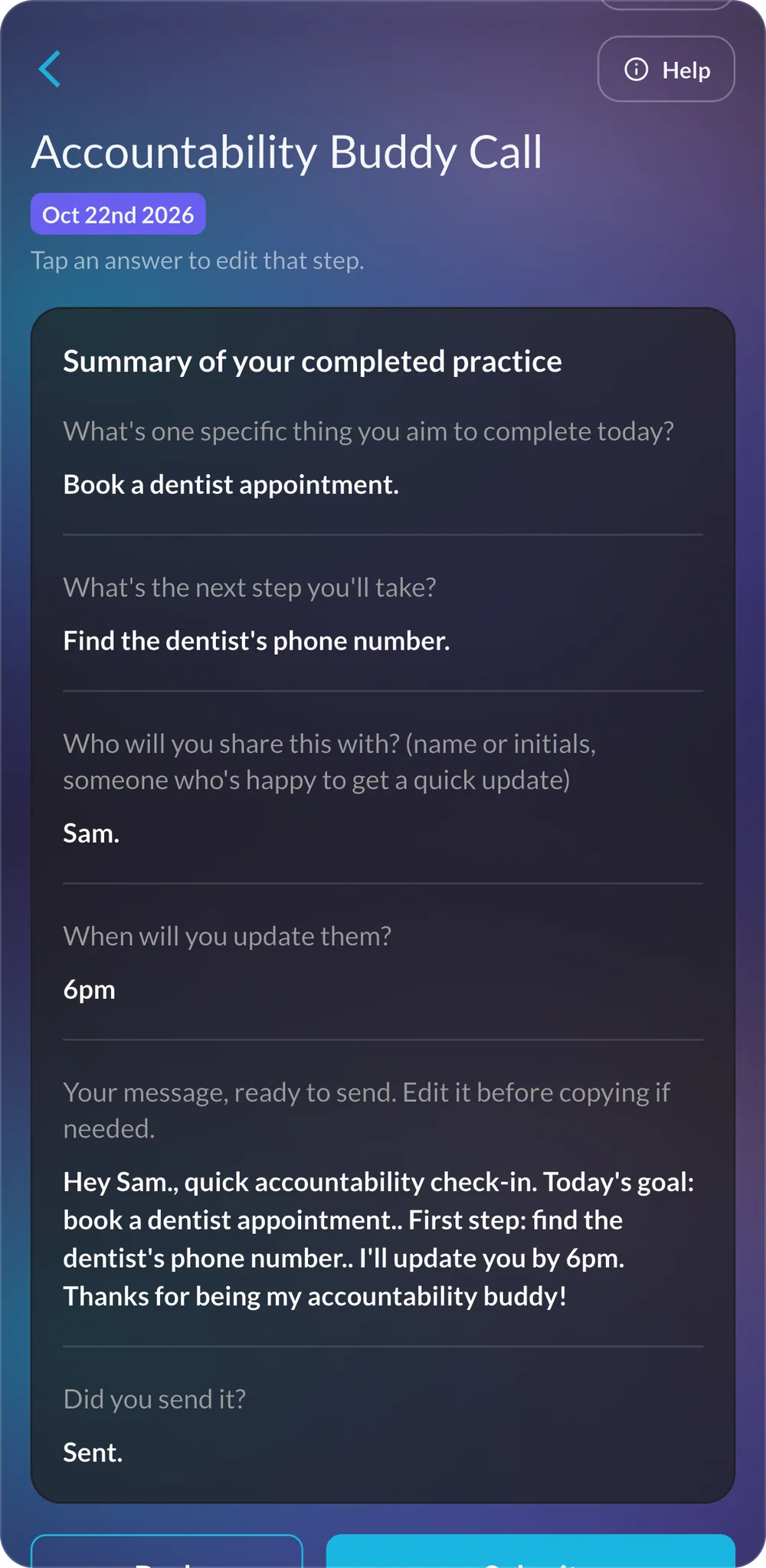
Journaling, self-paced, one question at a time. Its job in the program is discipline. Your entries stay private and are not sent to an outside AI or sold for advertising or any other reason. In the app it is called Accountability Buddy Call.
Related techniques
Breathtaking Premium gives you unlimited access to the Accountability Buddy Call and 22 other journaling practices.
These practices are tools for nervous system regulation. The guide explains what it is, the signs you need it, and how to start.
Your personalized program picks one to three of these a day, in the minutes you have.
Try 7 days free