Journaling
NVC ReflectionYour feelings, the needs beneath them, and one clear request
Last updated
What NVC Reflection is
Nonviolent Communication has four parts, and this nonviolent communication exercise walks through them on paper. Observation: what happened, stated as fact, with no blame in it. Feeling: how you feel about it, up to three words. Need: the need underneath the feeling, consideration, respect, rest, being heard. Request: one positive, concrete ask, who, what, when, to the other person or to yourself. The last question is practical: what will you do with the ask, send it, say it in person, keep it as a note, or do it yourself.
NVC Reflection vs the Emotion Wheel
The Emotion Wheel finds the precise feeling and stops there. NVC Reflection takes the feeling on to the need beneath it and the request that would meet it.
How to do NVC Reflection
Because it asks you to look honestly at painful or conflicted moments, give yourself a settled moment before you begin.
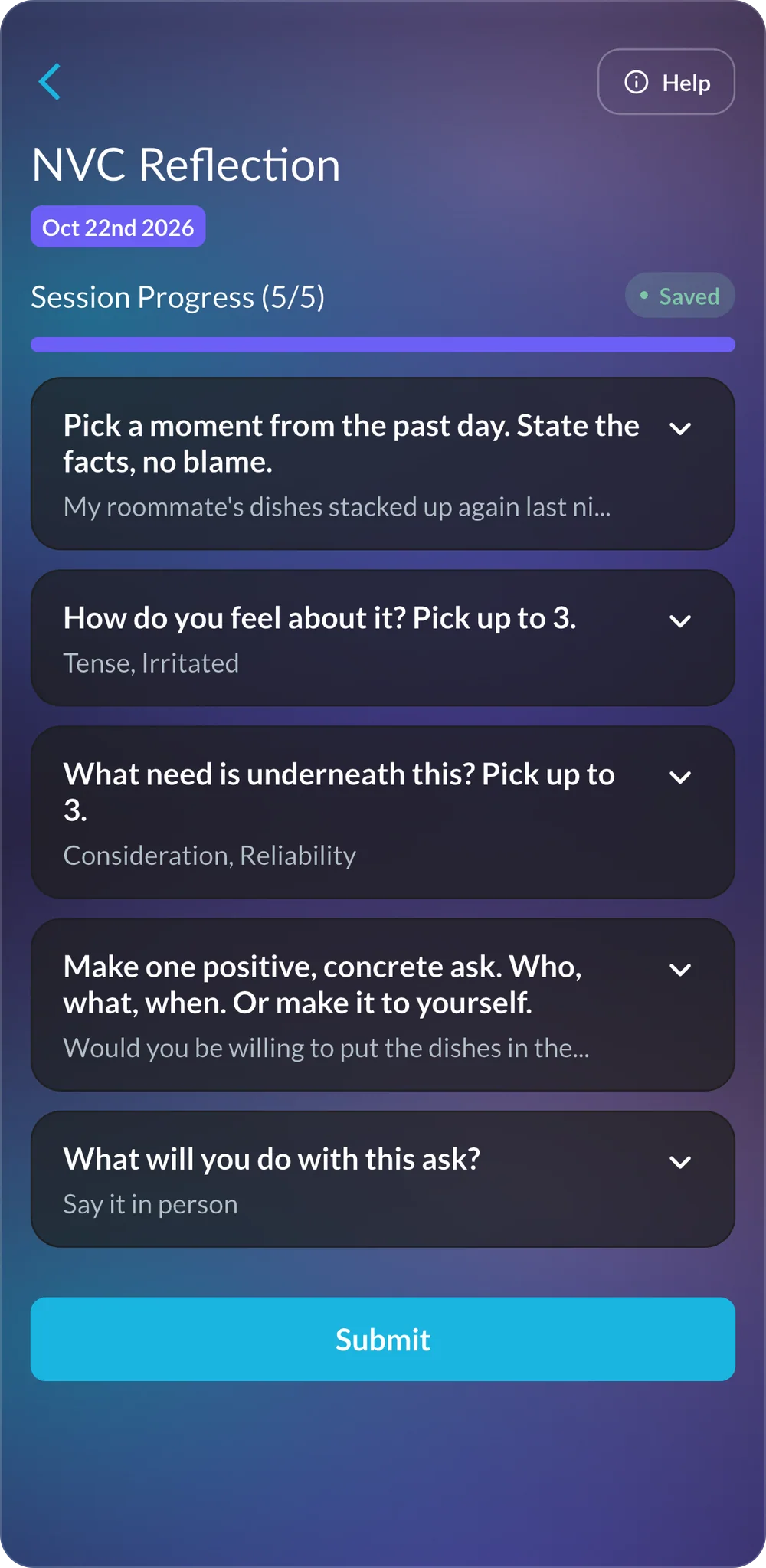
- Pick a moment from the past day. State the facts, no blame.
- How do you feel about it? Pick up to three.
- What need is underneath this? Pick up to three.
- Make one positive, concrete ask. Who, what, when. Or make it to yourself.
- What will you do with this ask? Send it now, say it in person, keep it as a note, do the self-request.
An NVC Reflection example
The facts: my roommate's dishes stacked up again last night. The feelings: tense, irritated. The needs: consideration, reliability. The request: would you be willing to put the dishes in the sink tonight and rinse them? What I'll do: say it in person.
In Breathtaking the exercise is guided, one question at a time, with the feelings and needs offered as choices. If journaling is new to you, what journaling is and how it works covers the basics.
What happens when you write it down
Separating what happened from how you feel and what you need cuts through blame and reactivity, which helps you see a situation more clearly and respond from need rather than upset. Stating the facts without blame is harder than it sounds and does most of the work: "the dishes stacked up" can be discussed, "you never clean up" cannot. Finding the need turns an accusation into information, and a request the other person can actually do is one they can say yes to. You may feel the sting of a conflict resurface, then a softening or clarity as you name the need underneath it.
What it's used for
A conflict that keeps replaying as an argument in your head. The message you want to send and know you should not, yet. Boundaries you have never managed to state. Anyone who goes quiet in conflict and explodes later.
What the research says about NVC Reflection
Nonviolent Communication journaling, which involves identifying observations, feelings, needs, and requests, has been tested in healthcare and corrections settings. Studies with nursing students and male parolees found significant increases in empathy after 8 weeks of practice (Nonviolent Communication training increases empathy in baccalaureate nursing students: A mixed method study, Nosek et al., 2014; Nonviolent communication training and empathy in male parolees, Journal of Correctional Health Care, 2012). Over 90% of people trained in NVC report lasting life changes, with improved ability to pause before reacting and stay centered during conflict.
Where it comes from
NVC was developed by psychologist Marshall Rosenberg as a framework for compassionate, needs-based communication in the 1960s and 70s, taught first in schools and civil rights mediation and later around the world. The written reflection, observation, feeling, need, request, is the framework's own sequence, done alone before it is done out loud. On the techniques page it sits with the modern methods.
When to use it
After the charged moment, before the reply. Before a conversation you are bracing for, so you know what you need from it. Weekly, with the recurring friction in a relationship, until the request has been made. It sits next to the CBT Thought Log, for when the problem is a thought rather than a need, and the Compassionate Letter, for when the request has to be made to yourself.
NVC Reflection in Breathtaking
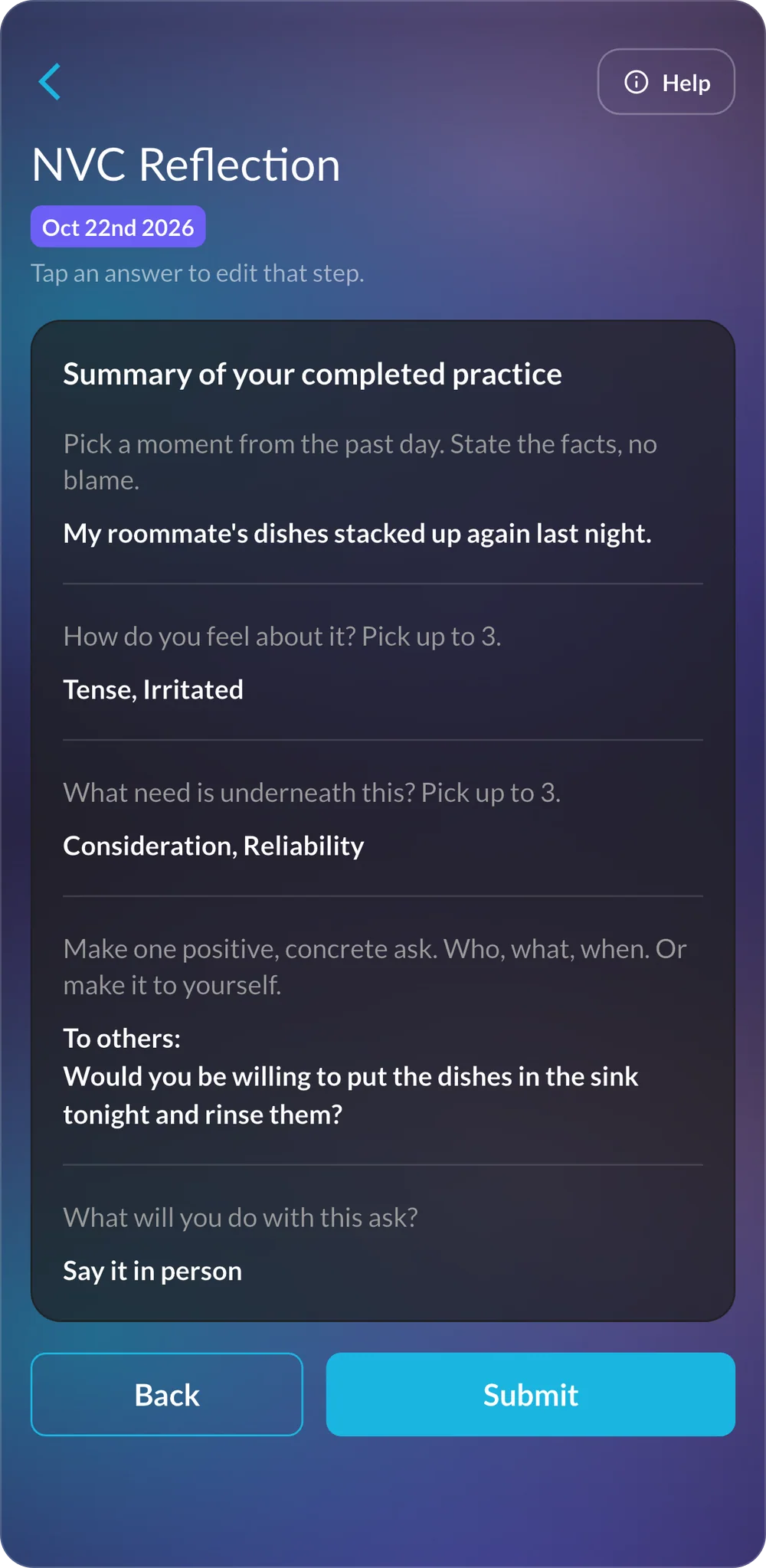
Journaling, self-paced, one question at a time. Calming; its job in the program is compassion, with defusion second. Your entries stay private and are not sent to an outside AI or sold for advertising or any other reason. In the app it is called NVC Reflection.
Frequently asked questions
What are the four components of Nonviolent Communication?
Observation, feeling, need and request. NVC Reflection walks through them in that order, on paper, before you say any of it out loud.
How can you practice NVC Reflection daily?
One reflection a day on one moment, however small, is the practice: the facts without blame, the feeling, the need, and one ask. The nonviolent communication exercise gets faster with repetition until the four steps happen in your head.
What does an NVC request look like?
Positive, concrete and doable: who, what, when. "Would you be willing to put the dishes in the sink tonight and rinse them?" rather than "stop being so messy."
Related techniques
Breathtaking Premium gives you unlimited access to NVC Reflection and 22 other journaling practices.
These practices are tools for nervous system regulation. The guide explains what it is, the signs you need it, and how to start.
Your personalized program picks one to three of these a day, in the minutes you have.
Try 7 days free