Journaling
Contemplating ImpermanenceOne ordinary thing that changed today, followed to its end
Last updated
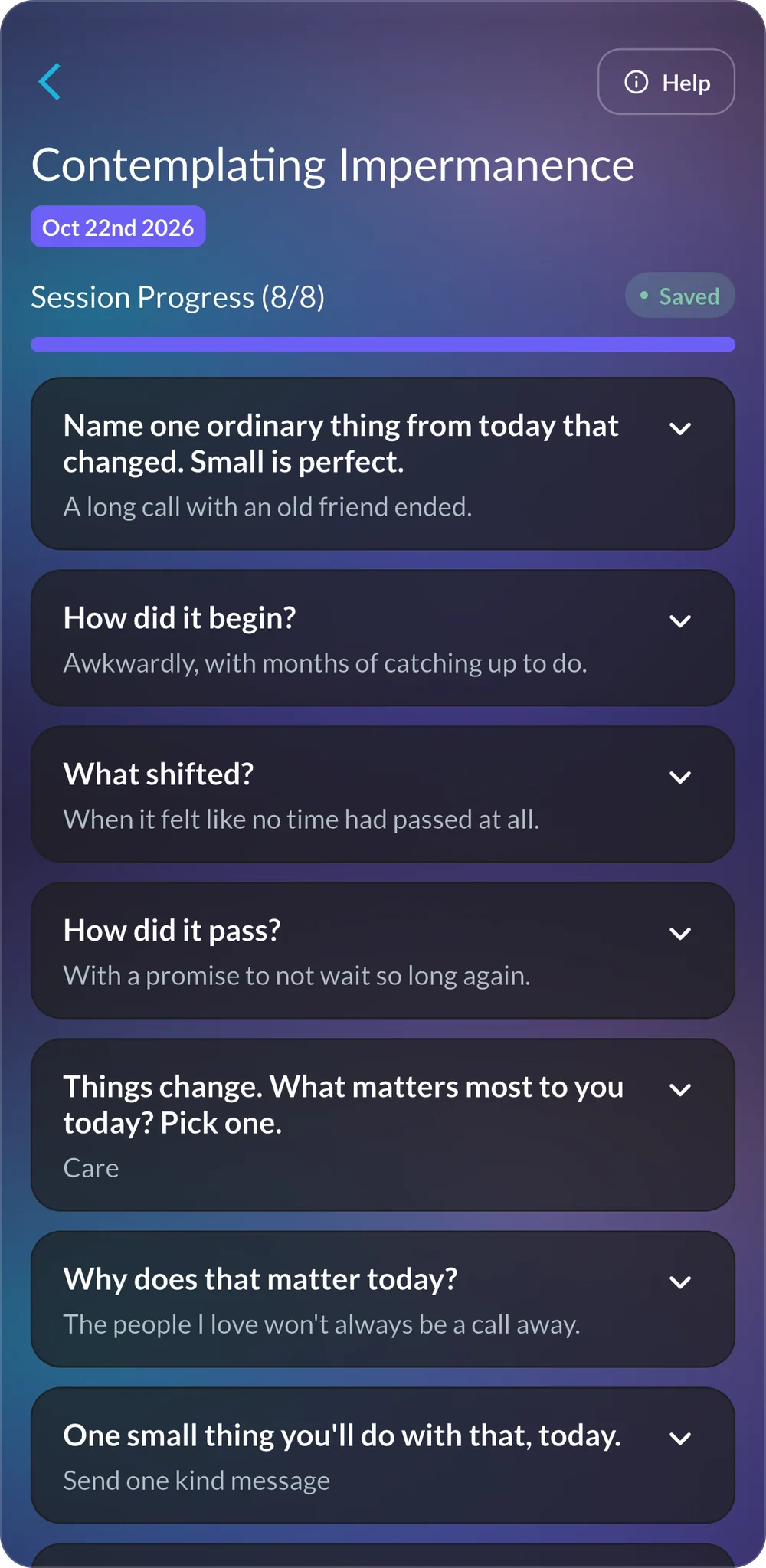
What Contemplating Impermanence is
A central Buddhist teaching is that everything changes, and the practice is to notice it in something small enough to see whole. The app asks for one ordinary thing from today that changed: a call that ended, a sunset that came early, a mood that lifted. You write how it began, what shifted, and how it passed. Then the practice turns: things change, so what matters most to you today, and why, and one small thing you will do with that. The reflection is assembled from your answers. An impermanence meditation does the same work in stillness; the writing does it with a pen and a real example.
Contemplating Impermanence vs Vipassana
Vipassana watches impermanence happen, sensation by sensation, in silence. Contemplating Impermanence writes one instance of it down and asks what it changes about today.
How to do Contemplating Impermanence
Because it can bring up thoughts of loss or mortality, give yourself a settled moment before you begin.
- Name one ordinary thing from today that changed. Small is perfect.
- How did it begin?
- What shifted?
- How did it pass?
- Things change. What matters most to you today? Presence, care, kindness, patience, gratitude, honesty, courage, simplicity.
- Why does that matter today?
- One small thing you'll do with that, today.
- Read your reflection, assembled from your answers, and edit anything.
A Contemplating Impermanence example
The change: a long call with an old friend ended. It began: awkwardly, with months of catching up to do. It shifted: when it felt like no time had passed at all. It passed: with a promise to not wait so long again. What matters: care, because the people I love won't always be a call away. The tiny act: send one kind message. The reflection: "Today, a long call with an old friend ended. It began awkwardly, with months of catching up to do, it changed when it felt like no time had passed at all, and it passed with a promise to not wait so long again. Care matters because the people I love won't always be a call away. Because of that, I will send one kind message."
In Breathtaking the exercise is guided, one question at a time, and the reflection is assembled from your answers. If journaling is new to you, what journaling is and how it works covers the basics.
What happens when you write it down
Gently facing the truth that everything changes loosens the grip of clinging and worry, and paradoxically can deepen appreciation for the present, since you see it won't last. Following one small thing through its whole arc, beginning, change, end, makes the teaching concrete. Ending with a value and an act keeps the reflection from tipping into sadness. You may feel a wistful poignancy, a surprising sense of peace, or fresh appreciation for ordinary things.
What it's used for
Worry that grips too hard. Change you are resisting. Loss, or the anticipation of it. Perspective, on the days the small things have grown large.
What the research says about Contemplating Impermanence
A 2019 study with 25 advanced meditators found that contemplating life's changing nature reduced negative emotions by 24% and increased compassion by 16% compared to regular mindfulness (New Study Suggests Meditating on Emptiness Might Be Better than Mindfulness, Lion's Roar, 2019). A 2025 brain imaging study of 38 meditators showed they had significantly less fear-based brain reactions to thoughts about death, and these changes correlated with greater overall wellbeing (Training the embodied self in its impermanence: meditators evidence neurophysiological markers of death acceptance, Neuroscience of Consciousness, 2025). The practice appears to rewire how your brain processes uncertainty and loss.
Where it comes from
Contemplating impermanence is a central Buddhist practice, used for millennia to ease attachment and meet change with equanimity. Anicca, impermanence, is the first of the three marks of existence in the Buddha's teaching, and reflecting on it runs through the Buddhist schools, from the Theravada contemplations to the Tibetan reflections on death. On the techniques page it sits with the practices of the Buddhist tradition.
When to use it
The evening, with one thing from the day. A season of change, weekly. The days a worry has grown larger than its subject. It sits next to Precious Human Life, the Buddhist reflection on what impermanence makes precious, and Karma, Cause and Effect, which follows a choice the way this practice follows a change.
Contemplating Impermanence in Breathtaking
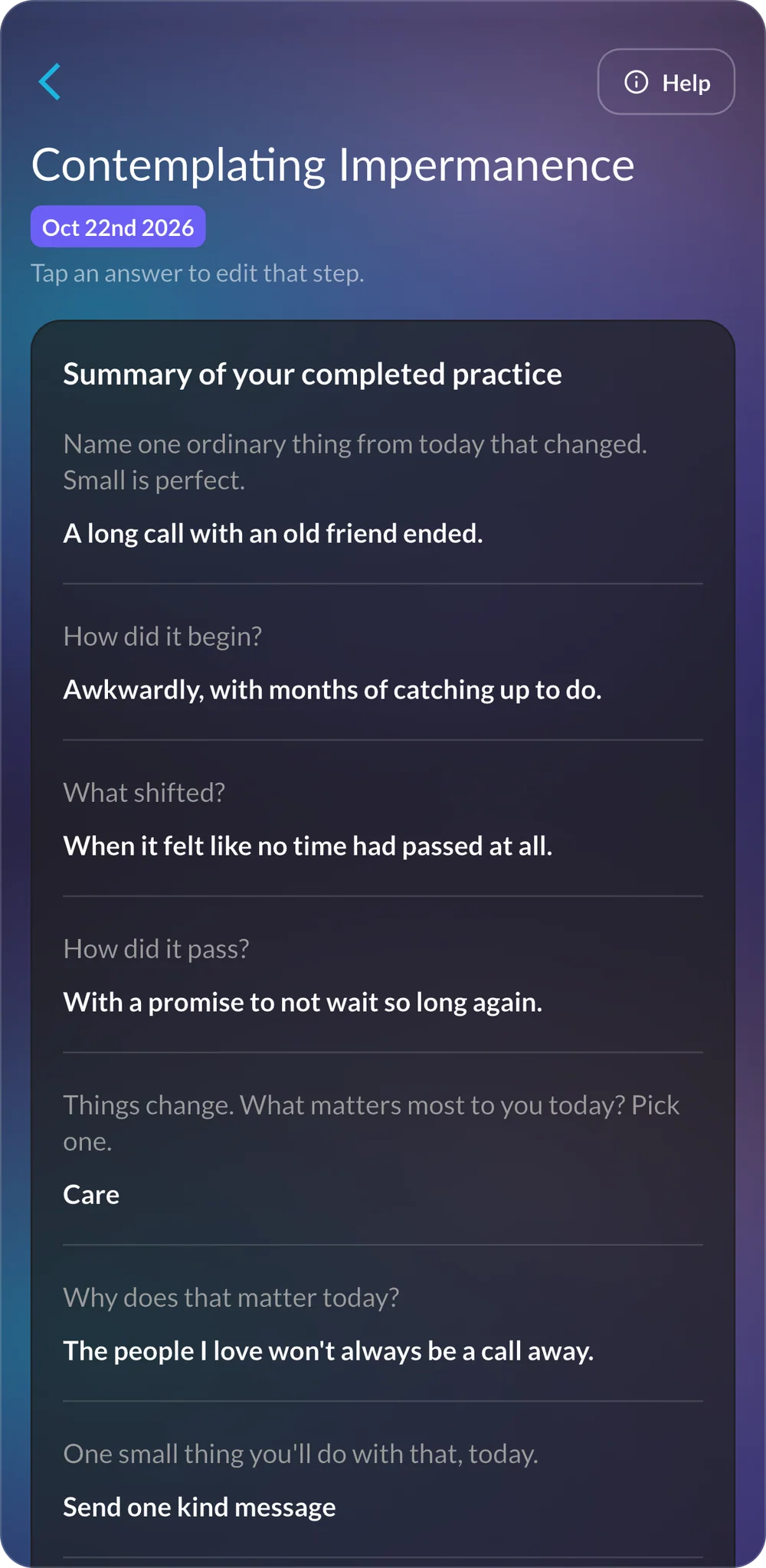
Journaling, self-paced, one question at a time. Its job in the program is insight, with defusion second. Your entries stay private and are not sent to an outside AI or sold for advertising or any other reason. In the app it is called Contemplating Impermanence.
Frequently asked questions
What does Buddhism say about impermanence?
That everything that arises passes, anicca, and that suffering comes from holding on to what cannot stay. Contemplating Impermanence is the practice of seeing that in one real thing rather than agreeing with it in the abstract.
How do you practice contemplating impermanence?
Take one ordinary thing from today that changed and write how it began, what shifted and how it passed. Then name what matters most to you because things change, and do one small thing with it today; an impermanence meditation reaches the same place in silence.
What is the point of contemplating impermanence?
Holding life more lightly, and appreciating what is here while it is here. In the studies above, the practice lowered negative emotion and the fear response to thoughts of death, and raised compassion.
Related techniques
- Precious Human LifeWriting on the rarity and possibility of your life, to refocus on what matters.
- Vipassana MeditationObserving sensations, thoughts and feelings as they arise, without reacting, to sharpen awareness.
- Karma, Cause & EffectTracing a choice of yours to its consequences, to act with more intention.
Breathtaking Premium gives you unlimited access to Contemplating Impermanence and 22 other journaling practices.
These practices are tools for nervous system regulation. The guide explains what it is, the signs you need it, and how to start.
Your personalized program picks one to three of these a day, in the minutes you have.
Try 7 days free