Journaling
ABC-DE DisputationThe event, the belief, the feeling, then the belief disputed
Last updated
What ABC-DE Disputation is
The ABC model is Albert Ellis's map of how a feeling gets made. A is the activating event, what actually happened. B is the belief, what your mind said about it. C is the consequence, the feeling that followed, and the model's whole point is that C comes from B, not from A. D is the disputation: the evidence for the belief, the evidence against it, a check for a familiar thinking pattern, and one question, does keeping this belief help me do what matters. E is the effective new belief, one truer, kinder line that fits both sides of the evidence, and the feeling rated again.
ABC-DE Disputation vs the CBT Thought Log
The CBT Thought Log works on a single automatic thought. ABC-DE Disputation works on the belief underneath it, the rule about yourself or the world that keeps producing the same thoughts, which is why it is the one for a feeling that keeps coming back.
How to do ABC-DE Disputation
- What happened? Just the facts.
- What did your mind say about it?
- What's the main feeling? Pick one.
- What is the intensity of the feeling? 0 to 10.
- Facts that support the belief. Be a fair judge, no guesses.
- Facts that don't fit the belief, or point the other way.
- Does the belief fit a familiar pattern? All-or-nothing, catastrophizing, mind-reading, shoulds, personalization, over-generalizing, overthinking. Pick one if it does, skip if not.
- If I keep this belief, does it help me do what matters? Yes or no.
- Write one truer, kinder line that fits both sides of the evidence.
- Rate that same feeling again.
An ABC-DE Disputation example
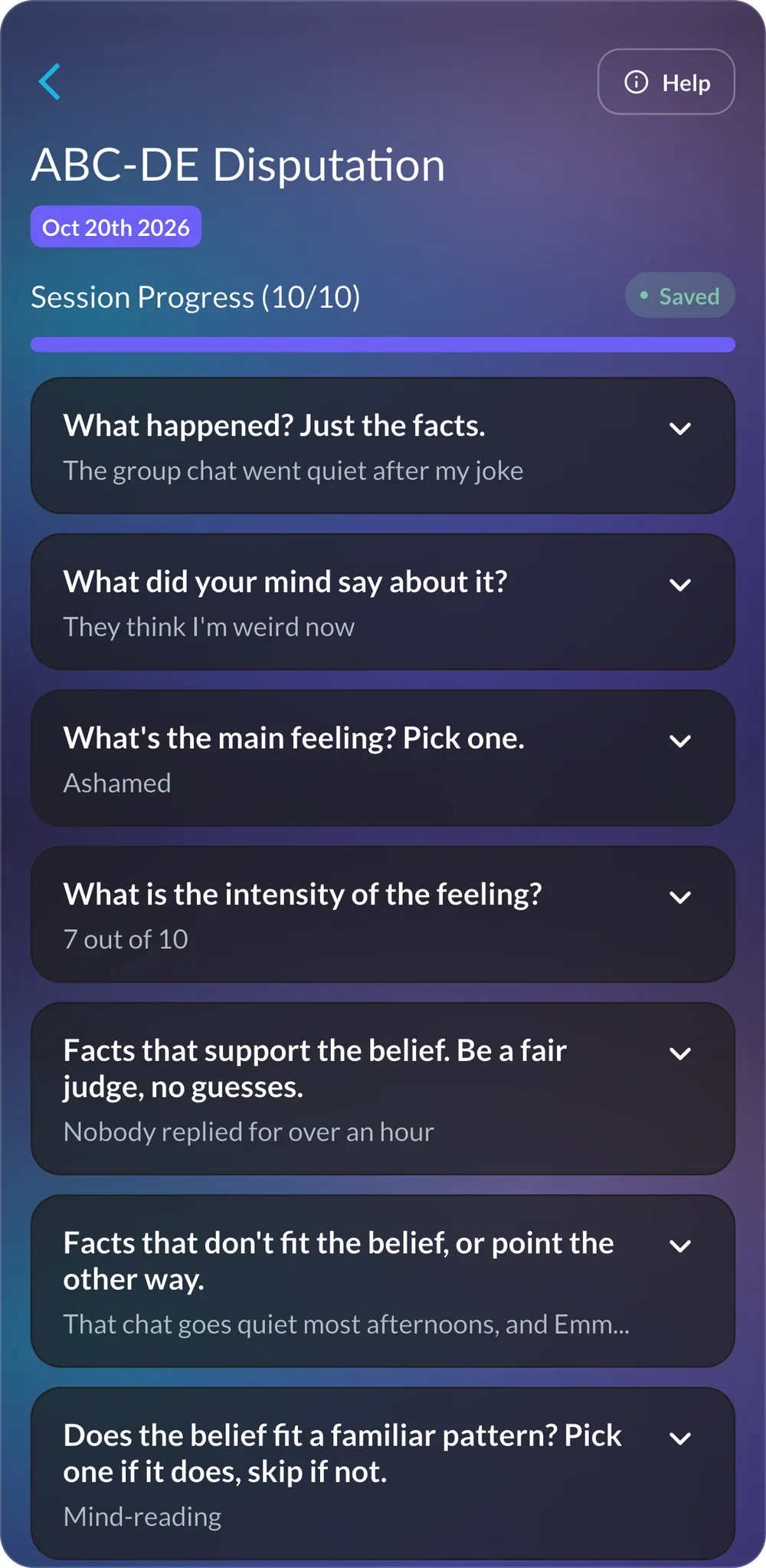
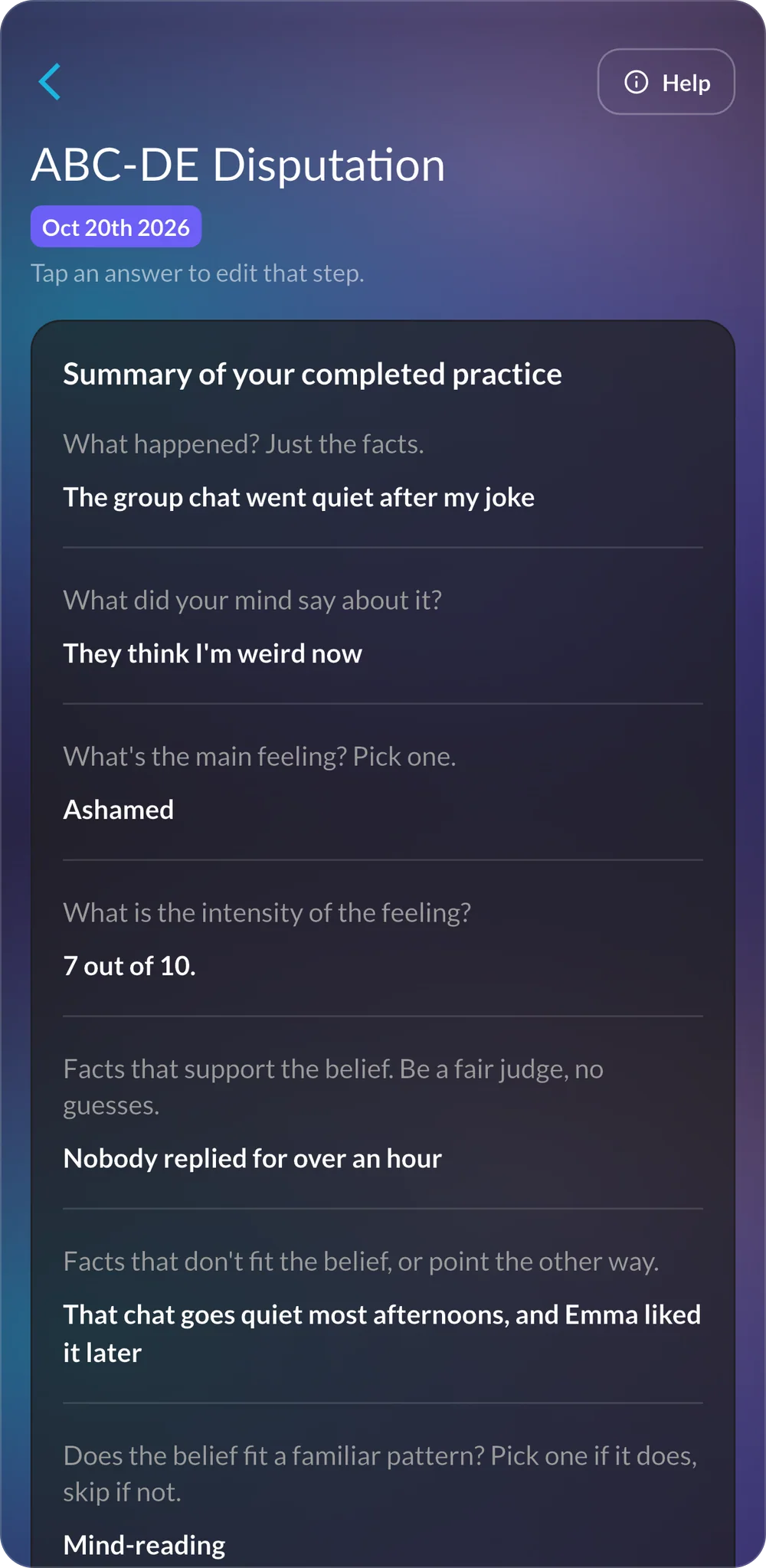
What happened: the group chat went quiet after my joke. What my mind said: they think I'm weird now. The feeling: ashamed, 7 out of 10. Evidence for: nobody replied for over an hour. Evidence against: that chat goes quiet most afternoons, and Emma liked it later. The pattern: mind-reading. Does keeping it help: no. The new belief: even if the joke landed flat, a quiet chat isn't a verdict. The feeling now: 3 out of 10.
In Breathtaking the exercise is guided, one question at a time, with the thinking patterns picked from a list. If journaling is new to you, what journaling is and how it works covers the basics.
What happens when you write it down
Laying out the event, the belief, and its emotional consequence shows that it's the belief, not the event, driving the feeling, and actively disputing that belief opens room for a steadier response. Writing the evidence in two columns forces the fair-judge stance the mind skips when it is upset. Naming the pattern, mind-reading, catastrophizing, does something on its own: once the belief has a label it looks like a habit rather than a fact. You may feel resistance as you question a belief you hold strongly, then some relief or openness as it loosens.
What it's used for
A belief that keeps producing the same bad feeling. Catastrophizing before an event. Thought spirals that loop without new facts. The story you tell about yourself after a mistake.
What the research says about ABC-DE Disputation
This technique from Rational Emotive Behavior Therapy has 50 years of research across 84 studies. A major review found it reduces anger with medium effect size (d = 0.52), depression with medium-large effect size (d = 0.61), and general distress with large effect size (d = 0.94) (50 years of rational-emotive and cognitive-behavioral therapy: A systematic review and meta-analysis, 2017). The practice involves identifying triggering events (A), beliefs (B), consequences (C), disputing irrational thoughts (D), and creating effective new beliefs (E). Effects last long after practice ends.
Where it comes from
The model was created by psychologist Albert Ellis, a founder of cognitive therapy, in the 1950s, with the disputing and new-effect steps added to work with the belief. Ellis took the core idea from the Stoics, from Epictetus's line that people are disturbed not by things but by their views of things, though on the techniques page it sits with the modern methods, because its form is modern.
When to use it
The same day as the event, while the belief is still in its own words. Once a week on the belief that keeps returning, until the new line starts to arrive on its own. It sits next to Stoic Premeditation, the same philosophy applied before the event instead of after, and the Emotion Wheel, which helps name the C when the feeling is hard to place.
ABC-DE Disputation in Breathtaking
Journaling, self-paced, one question at a time. Its job in the program is defusion, getting distance from a belief. Your entries stay private and are not sent to an outside AI or sold for advertising or any other reason. In the app it is called ABC-DE Disputation.
Frequently asked questions
What is the ABC model in REBT?
A, the activating event; B, the belief about it; C, the consequence, the feeling. The model's claim is that the belief, not the event, produces the feeling, which is why changing the belief changes the feeling.
What do D and E stand for in ABC-DE Disputation?
D is disputation: testing the belief against the evidence, checking it for a familiar pattern, and asking whether it helps. E is the effective new belief, a truer line that fits the evidence, and the feeling rated again.
How is ABC-DE Disputation different from a thought record?
A thought record examines one automatic thought. ABC-DE Disputation goes after the belief underneath, the rule that keeps generating the thoughts, and adds the question of whether the belief helps you do what matters.
Related techniques
Breathtaking Premium gives you unlimited access to ABC-DE Disputation and 22 other journaling practices.
These practices are tools for nervous system regulation. The guide explains what it is, the signs you need it, and how to start.
Your personalized program picks one to three of these a day, in the minutes you have.
Try 7 days free