Meditation helps with emotional healing, but only when the technique matches what you're actually feeling. Most people who try it stop because they picked the wrong technique for the emotional state they're in. This guide walks through what meditation does to your body and mind, why different techniques suit different emotional states, and how to find the right practice for where you are right now.
What Meditation Is and How It Works
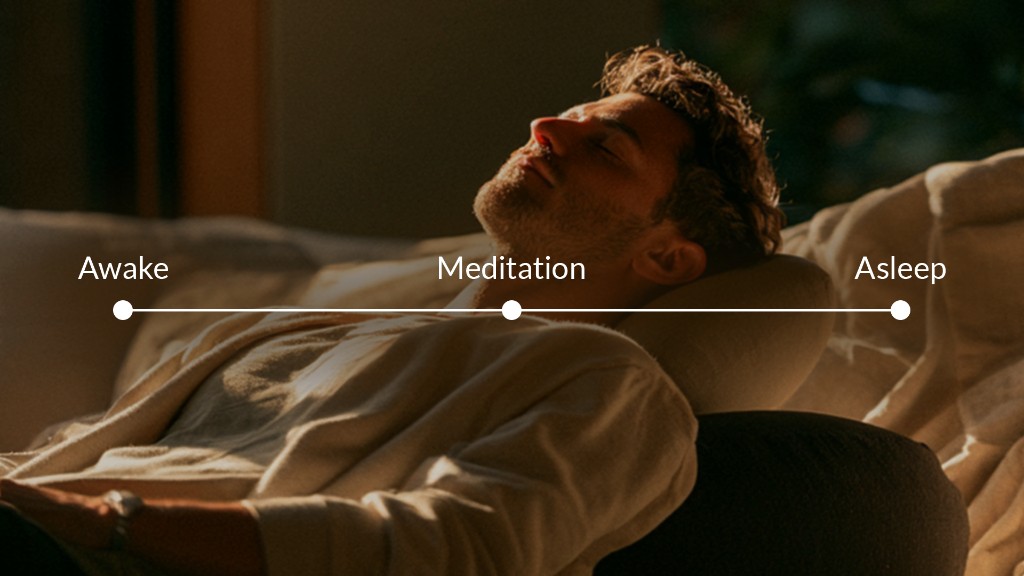
The two commonly known states of consciousness we know of are awake and asleep. Think of meditation as the third state of consciousness. You're fully awake and aware, but the mind is quiet and the body is deeply at rest. You're experiencing the present moment effortlessly, as it is. It's a state where you allow yourself to just be, and it allows your body to unbind the emotional knots that weigh down on you.
This is why meditation affects you differently than sleep or rest.
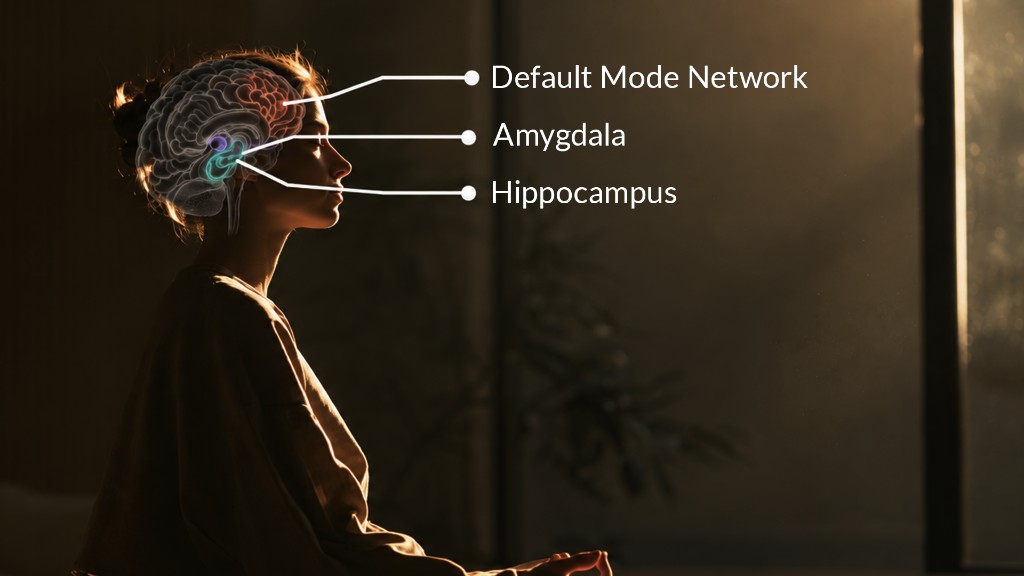
During sleep, your conscious mind shuts down. During rest, your body slows but your mind keeps going. In meditation, both happen at the same time. Your heart rate drops. Your breathing slows. Brain wave activity shifts from the faster patterns of ordinary thinking to slower, more coherent rhythms. The default mode network, the part of your brain responsible for rumination and self-critical thinking, quiets down. And yet you're still there, awake, present, aware of what's happening inside you.
This is the state where emotional healing becomes possible.
Why Emotions Get Stuck in the Body
Your body stores what it can't process.
When something happens that feels too big to be felt fully, your nervous system protects you by holding onto it. The emotion doesn't get processed. It gets stored.
Our everyday life as we have designed our society is full of micro and macro stressors, the pace is faster than our bodies can cope with processing everything, and on top of that we have unspoken rules about what we're allowed to feel and when.
Over months and years, the unprocessed emotions accumulate in the body.
Harvard psychiatrist and trauma researcher Bessel van der Kolk spent decades showing that unprocessed emotions are held in the body as physical sensations, altered stress responses, and long-term changes in how the body regulates itself.
How stored emotions show up:
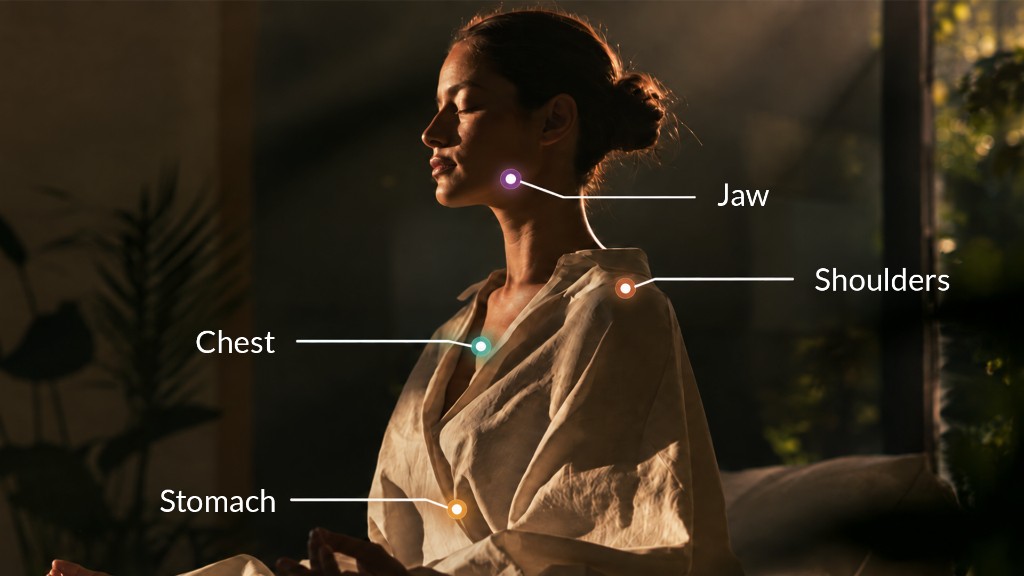
Restlessness when you try to sit still. Tension in your jaw, your shoulders, your chest. A pit in your stomach you can't explain. Racing thoughts at 2am that won't quiet down. Waking up exhausted after eight hours of sleep. Numbness when you know you should be feeling something. Irritability that rises faster than it should.
These are signs your body is holding emotions it hasn't been able to process. As long as they're held, they keep shaping how you feel, how you sleep, and how your nervous system responds to everything that comes next.
The two directions this tends to go are hyperarousal and hypoarousal. Hyperarousal is when the body gets stuck in a heightened state: anxious, wired, irritable, vigilant. Hypoarousal is the opposite: numb, flat, disconnected, heavy. Some people swing between the two.
If any of this sounds familiar, you're holding something your body hasn't finished processing. That's what meditation can help with. This guide to nervous system regulation goes deeper into what's happening and why.
How Meditation Helps Your Body Process Emotions
Meditation works through three distinct mechanisms, and each one is backed by research.
The first is that it physically changes the parts of your brain that process emotions. A 2025 study at Mount Sinai used intracranial recordings to measure what happens deep in the brain during meditation. They found that even first-time meditators showed measurable changes in activity in the amygdala and hippocampus after a short loving-kindness meditation. These are the brain regions that hold emotional memory and drive fear, anxiety, and reactivity.
The second is that meditation quiets the inner critic. Inside your brain there's a system called the default mode network. It runs when you're not focused on anything specific, and it's responsible for the constant self-referential narration that happens in your head. The "why did I say that," the "what's wrong with me," the replay of old conversations. Yale researchers found that experienced meditators show significantly reduced default mode network activity across multiple types of meditation.
The third is that meditation rebuilds your ability to feel your body. This is called interoception, the skill of sensing what's happening inside you. A 2025 meta-analysis of 29 studies found that mindfulness meditation reliably improves interoceptive awareness. This matters because you can't process an emotion you can't feel. People who struggle with anxiety, depression, and emotional numbness almost always have reduced interoception.
All three mechanisms are part of why Breathtaking's multi-modal approach has been reviewed and endorsed by a clinical psychologist.
When I started my daily practice, I didn't know any of this. The first few sessions were hard. I'd finish my breathwork, sit down to meditate, and my mind would go everywhere. I had to push through. But as the weeks went by, it got easier. The thoughts would still come, but I stopped clinging to them. They'd come and go in the background while I stayed with my breath. The feeling of peace I'd get from the session would dissipate as the day went on, but the longer I practiced, the longer it stayed.
Why Breathwork Is the Natural Starting Point for Meditation
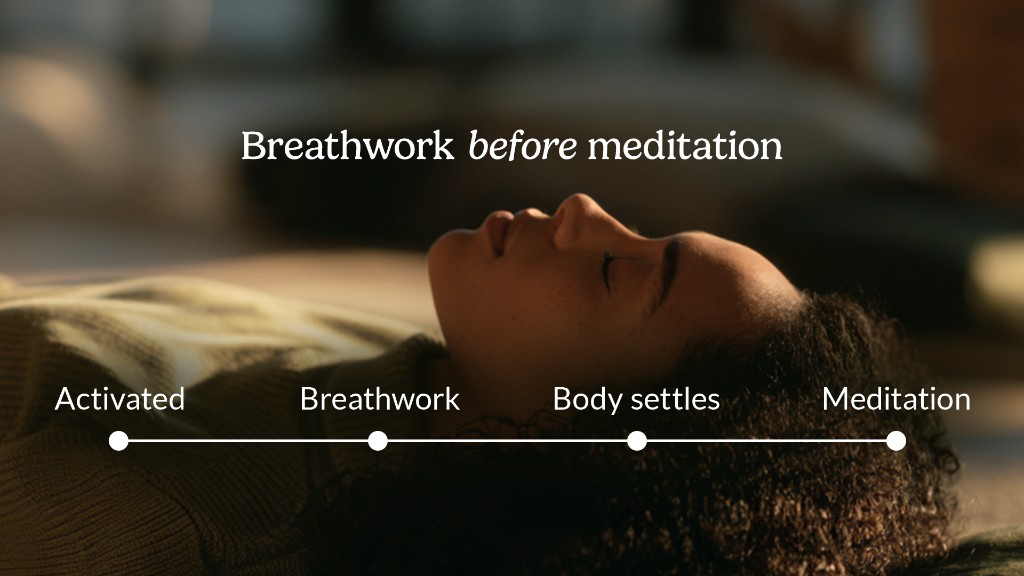
If your nervous system is activated right now, sitting down to meditate is going to feel almost impossible. Your mind will race, your body will feel restless, and you'll probably decide after a few minutes that meditation isn't for you. When your body is in fight or flight, asking it to sit still and observe is like asking a car with the engine revved to idle quietly. It can't, not without intervention first.
Breathwork is the intervention.
A 2023 Stanford study compared five minutes of breathwork against five minutes of mindfulness meditation. Exhale-focused breathing produced significantly greater improvements in mood and reductions in physiological arousal than just meditation did. The effects compounded with each day of practice. Breathwork activates the parasympathetic nervous system directly through the vagus nerve, which means it doesn't require quieting your mind or any cognitive effort. You just breathe.
For most people, the sequence that works is breathwork first, meditation right after. Five minutes of slow exhale-focused breathing calms the body, and once the system is somewhat regulated, meditation goes deeper than it could have otherwise.
If you've tried meditation before and it didn't work, the issue may not have been the meditation. Your body wasn't ready to receive it yet. This breathwork for beginners guide walks you through how to start.
The Meditation Techniques for Emotional Healing
There are many different meditation techniques, and they come from different places. Some are ancient Buddhist practices, some come from Hindu tradition, and some were developed more recently by modern teachers and researchers. Each one does something different to your body and mind, and the one that would work for you depends on what you're actually feeling.
Below are ten techniques, grouped by the emotional state they're best suited for.
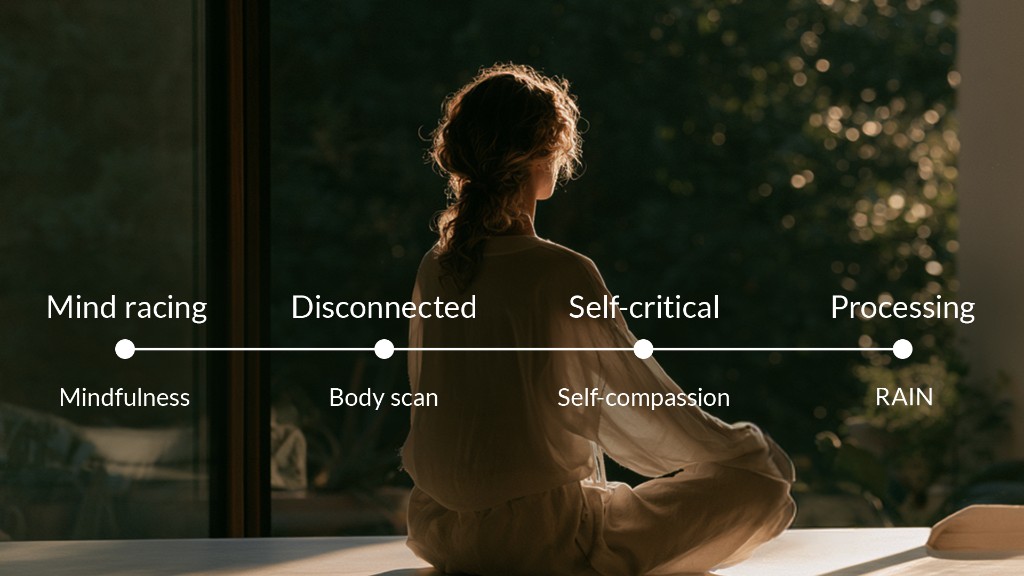
When You're Anxious or Your Mind Is Racing
Mindfulness Meditation is a core Buddhist practice adapted for secular use, and it's the most studied technique for anxiety and emotional reactivity. You sit, you notice your thoughts, and you let them pass without attaching to them. Over time, this creates space between you and the thought storm. You stop being the thoughts and become the one watching them.
Mantra Meditation works when the mind is too busy for mindfulness. You anchor your attention to a repeated word, sound, or phrase. This has roots in Hindu tradition going back thousands of years. The mantra gives the thinking mind something to do, so it stops hijacking the practice. A meta-analysis of mantra-based meditation found it reduces anxiety and PTSD symptoms across clinical populations.
Zen Meditation, or zazen, comes from the Japanese Buddhist tradition. It's "just sitting" with no focus object and no goal. This practice helps with the striving, achievement-driven kind of anxiety, the kind that makes you feel like you're always falling short. The non-striving nature of zazen is itself the medicine.
When You Feel Numb or Disconnected
Body Scan Meditation comes from the Vipassana tradition and is the most direct tool for numbness and dissociation. You move your attention slowly and systematically through each part of your body, noticing whatever sensations are there without trying to change anything. The practice rebuilds the connection between you and your body. If you can't tell what you're feeling, or you feel disconnected from yourself, body scan is where to start.
Yoga Nidra, or yogic sleep, is a guided practice where you lie down and follow a teacher's voice through a systematic relaxation. Your body enters a state of conscious rest somewhere between waking and sleep. It's especially useful for states of deep exhaustion, trauma, and hypoarousal. Research on yoga nidra shows it reduces anger, anxiety, and emotional reactivity in people with PTSD while increasing relaxation and self-awareness. It's endorsed by the U.S. Army Surgeon General. If sitting still feels impossible, yoga nidra is a good place to start because you're lying down.
When You're Being Hard on Yourself
Self Compassion Meditation was developed by researcher Kristin Neff, drawing on Buddhist principles of self-kindness. The practice trains you to speak to yourself the way you'd speak to a good friend going through the same thing. If the voice in your head is constantly telling you you're not enough, this is the practice built to change that voice. Neff's work, drawing on more than 4,000 studies, shows self-compassion reduces shame, depression, anxiety, and perfectionism while increasing emotional resilience.
Loving Kindness Meditation, or metta, comes from the Buddhist tradition and goes back 2,500 years. You silently send goodwill first to yourself, then to people you love, then to people you feel neutral about, and finally to people you're in conflict with. It's especially powerful for anger, isolation, and the feeling that you're separate from everyone else.
When You're Processing Something Difficult
RAIN Meditation was developed by the Buddhist teacher Tara Brach, and it's one of the most practical tools for working with acute emotional pain in the moment. RAIN stands for Recognize, Allow, Investigate, Nurture. You recognize what you're feeling, allow it to be there without pushing it away, investigate where it lives in your body, and offer yourself nurturing attention. It's a structured protocol for the moments when something overwhelming shows up and you don't know what to do with it.
Vipassana Meditation is the original insight practice from the Buddhist tradition, going back more than 2,500 years. It's the practice of observing reality as it is, including the parts that are hard to look at. A 2024 systematic review of Vipassana research found consistent reductions in stress and anxiety, along with improvements in mindfulness and emotional regulation. This isn't for acute emotional distress. It's for the slower work of understanding why the same emotional patterns keep repeating.
Gratitude Meditation draws from the Buddhist concept of mudita, or appreciative joy. You bring to mind specific things you're grateful for and sit with the felt sense of appreciation. This isn't the practice for acute pain. It's for persistent low mood, negativity bias, and the feeling that nothing matters anymore. Meta-analyses of gratitude interventions show consistent reductions in depression symptoms with regular practice.
Meditation Works Best as Part of a Bigger Practice
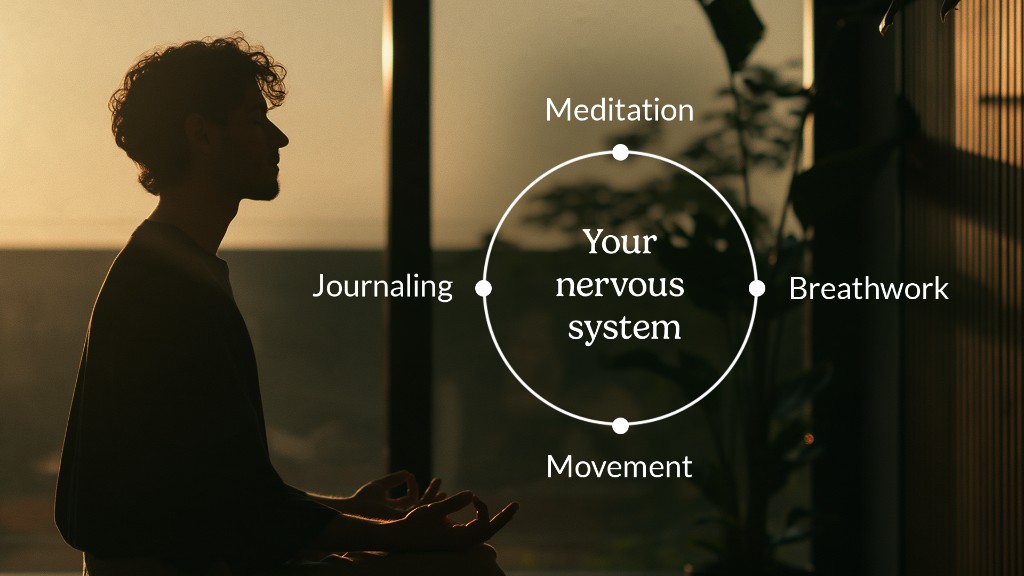
Meditation alone won't regulate a nervous system that's been dysregulated for years. It works best alongside breathwork, movement, and journaling, each of which addresses a different layer of what your body holds. If your system is in hyperarousal, breathwork regulates it faster than meditation can. If you're holding something you can't name, journaling reaches places meditation doesn't. If your body is stuck, movement is the doorway.
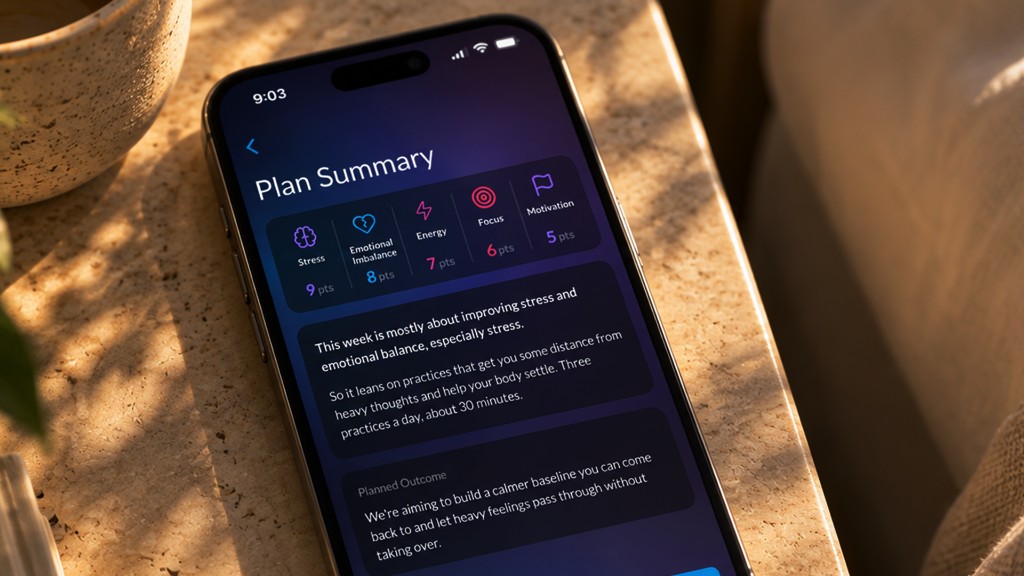
This is why I built Breathtaking. It's a nervous system regulation app that figures out your personality type, checks in with how you're feeling each week, and recommends the one modality your nervous system needs most right now. Some weeks that's meditation. Other weeks it's breathwork, movement, or journaling. Read how Breathtaking builds your weekly practice or start regulating your nervous system with Breathtaking.
Closing Thought
Emotional healing isn't something that happens in your head. It happens in your body, in the nervous system that's been holding what life hasn't given you space to process.
Meditation is one of the most direct ways to help your body do that work. The key is matching the technique to the state you're in. If you're anxious, mindfulness and mantra. If you're numb, body scan and yoga nidra. If you're being hard on yourself, self-compassion and loving kindness. If you're processing something specific, RAIN, Vipassana, or gratitude. Start with what your body is telling you today.
Frequently Asked Questions About Meditation for Emotional Healing
Does meditation help with emotional healing?
Yes. Meditation works on emotional healing through three specific mechanisms. It physically changes activity in the amygdala and hippocampus, the brain regions that hold emotional memory. It quiets the default mode network, the system responsible for rumination and self-critical thinking. And it rebuilds interoception, the ability to feel what's happening in your body. All three are backed by research, and together they help your nervous system process emotions that have been stored.
What is the best meditation for emotional healing?
The best meditation for emotional healing depends on the emotional state you're in. If you're anxious or your mind is racing, try mindfulness or mantra meditation. If you feel numb or disconnected, body scan or yoga nidra. If you're being hard on yourself, self-compassion or loving-kindness meditation. If you're processing something difficult, RAIN or Vipassana. Matching the technique to your state is what makes it work.
Why do I cry during meditation?
Crying during meditation is common, especially when you're starting a practice for emotional healing. When your nervous system relaxes enough, emotions you've been holding start to surface. This is the body doing the processing it wasn't able to do before. It's a sign the practice is working, not that something is wrong. If it becomes too intense, breathwork beforehand can help your system stabilize first.
Can breathwork help with emotional healing, or do I need meditation?
Breathwork and meditation work together. A 2023 Stanford study found that five minutes of breathwork produced greater immediate reductions in stress and improvements in mood than meditation did. Breathwork calms the nervous system directly through the vagus nerve, which creates the conditions for meditation to go deeper. For most people, breathwork first and meditation second is the sequence that works best for emotional healing.
How long does meditation for emotional healing take to work?
Research shows measurable brain changes from meditation in as little as 10 minutes of practice. For sustained emotional healing, 5 to 15 minutes of daily practice over 8 weeks produces the most consistent results in clinical studies. Consistency matters more than session length. A short daily practice will do more than a long practice once a week.

Alex is the founder of Breathtaking and a former Google Engineer and Product Manager. After experiencing burnout, he spent six months rebuilding himself through breathwork, meditation, and ancient philosophy. He now builds tools to help others do the same.